Stuffed Steak Pinwheels — Best 45-Min Ultimate Recipe
Some recipes look like they require a culinary degree and an hour of patience, but these
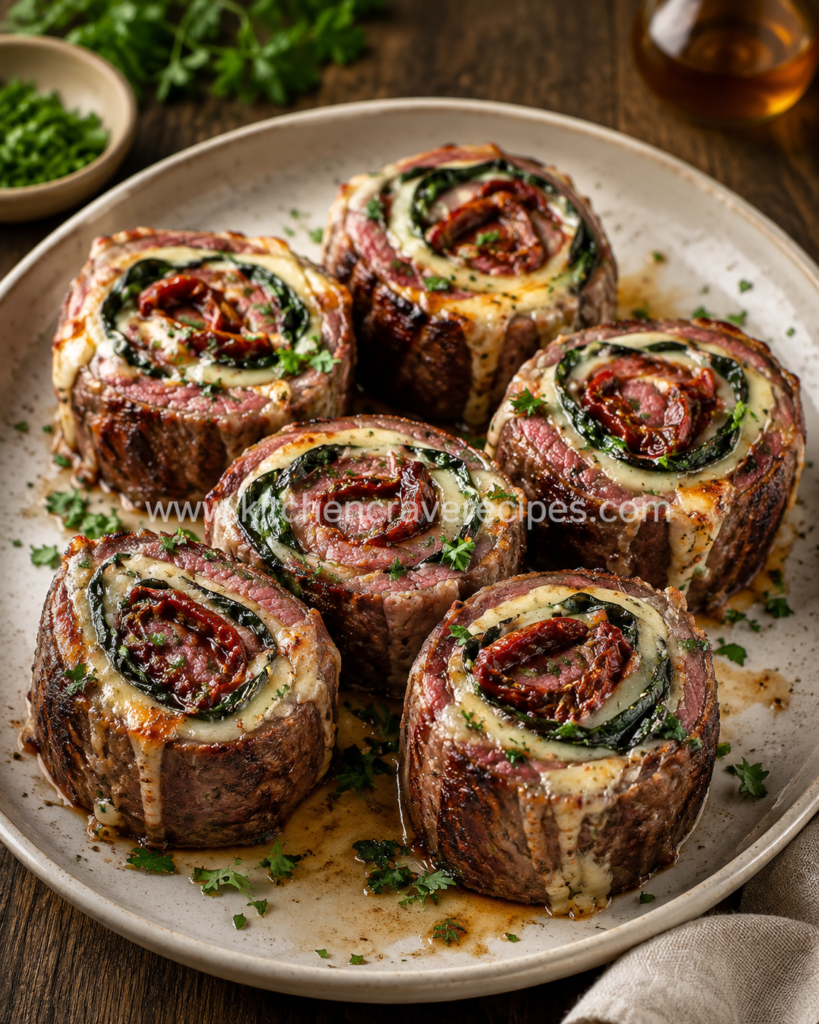
stuffed steak pinwheels prove that stunning and straightforward are not mutually exclusive. Look at what's visible in the photo: thick, beautifully browned pinwheel rounds sliced to reveal a tight spiral of medium-pink beef, wilted spinach, deep-red sun-dried tomatoes, and a layer of melted, lightly browned cheese — all arranged on a cream-colored plate and scattered with fresh parsley. Every cross-section is a picture.
Broiling is the technique that makes this recipe click for a weeknight cook. The oven's top element delivers intense, direct heat that sears the outside of each pinwheel rapidly — building a browned crust on the meat's surface and melting the cheese filling into the spiral — without requiring a skillet, multiple pans, or a prolonged cooking window. The whole thing, from rolling to resting, is done in 45 minutes. What you end up with is a dinner that genuinely impresses guests and satisfies a serious steak craving in equal measure.
Recipe Quick Info
| Detail |
Info |
| Prep Time |
25 minutes |
| Cook Time |
12 minutes |
| Total Time |
37 minutes (plus 5 min rest) |
| Servings |
4 (2 pinwheels per person) |
| Course |
Main Course |
| Cuisine |
American-Italian |
| Cooking Method |
Broiling |
| Calories |
~480 per serving |
| Difficulty |
Standard |
Why You'll Love These Stuffed Steak Pinwheels
- Visually spectacular with minimal effort — slicing the broiled roll into pinwheels creates an eye-catching spiral of beef, spinach, tomato, and cheese that looks far more complex than the assembly actually is.
- Broiler-fast, under 15 minutes of actual cook time — the oven's top element works quickly on thin-rolled steak, so you're never hovering over a stovetop babysitting a heavy roast for an hour.
- Deeply savory layered filling — sun-dried tomatoes bring concentrated, slightly sweet umami; wilted spinach adds earthiness and color; and melted provolone or mozzarella binds the spiral and caramelizes at the edges.
- Naturally low-carb and keto-friendly — the entire recipe as written contains no grains, no starches, and no added sugars, making it compatible with most low-carb eating patterns without any modifications.
- Scales easily for a dinner party — double or triple the recipe, broil in batches, and slice just before serving; the visual payoff multiplies with the quantity.
- Works as an appetizer or a full main course — slice the pinwheels thinner for a cocktail party platter, or serve two thicker rounds per person alongside a salad or roasted vegetables for a complete dinner.
- Adaptable filling without changing the technique — swap in different cheeses, add prosciutto for saltiness, or change the herbs without altering a single step of the rolling or broiling process.
Ingredients
For the Steak Roll
- 1½ lbs flank steak or skirt steak (butterflied and pounded to ¼-inch thickness — see Step 1)
- 1 teaspoon kosher salt
- ½ teaspoon black pepper
- ½ teaspoon garlic powder
- ½ teaspoon smoked paprika
- 1 tablespoon olive oil (for brushing the exterior before broiling)
For the Filling
- 2 cups fresh baby spinach, lightly wilted (see Step 2)
- ½ cup sun-dried tomatoes in oil, drained and roughly chopped
- 1 cup shredded provolone cheese (or whole-milk mozzarella — both are visible-style melting cheeses that create the layered look in the photo)
- 2 tablespoons fresh flat-leaf parsley, finely chopped
- 2 cloves garlic, finely minced
- 2 tablespoons cream cheese, softened (helps bind the filling and prevents it from falling out during rolling)
- ¼ teaspoon crushed red pepper flakes (optional)
For Finishing
- Extra fresh parsley, roughly chopped (for garnish, as shown in photo)
- Flaky sea salt, for finishing
- Lemon wedges, for serving (optional)
Optional Add-Ins
- 4 thin slices prosciutto, laid over the filling before rolling (adds saltiness and richness)
- 2 tablespoons grated Parmesan, scattered over the provolone layer
- 1 tablespoon fresh basil leaves, torn and added with the spinach
Substitution Guide
| Original Ingredient |
Substitution |
Notes |
| Flank steak |
Skirt steak or flat iron steak |
Skirt steak is thinner and more tender; flat iron has more marbling |
| Provolone cheese |
Whole-milk mozzarella or Gruyère |
Gruyère adds a nuttier, more complex melt; mozzarella is milder |
| Sun-dried tomatoes (oil-packed) |
Roasted red peppers, drained |
Sweeter and less acidic; still provides color and moisture |
| Fresh baby spinach |
Frozen spinach, thawed and fully squeezed dry |
Squeeze out all moisture or the filling becomes watery during broiling |
| Cream cheese |
Ricotta cheese (drained) |
Slightly looser texture but still binds the filling effectively |
| Fresh parsley |
Fresh basil or fresh oregano |
Changes the herb character without affecting technique |
Kitchen Tools Needed
- Broiler-safe baking dish or heavy rimmed sheet pan — must withstand direct broiler heat at high temperature; ceramic, cast iron, or heavy stainless steel are all appropriate
- Oven broiler — set to HIGH; the top-element heat source is what creates the browned crust and melted cheese finish on the pinwheels
- Oven rack positioned 4–6 inches from the broiler element — measure before preheating; distance determines browning rate and cook speed
- Meat mallet or rolling pin — for pounding the butterflied steak to a uniform ¼-inch thickness across the entire surface
- Plastic wrap — for covering the steak while pounding, which keeps the meat fibers intact and prevents splatter
- Kitchen twine or metal toothpicks / skewers — for securing each pinwheel slice so it holds its spiral shape under the broiler's heat
- Sharp chef's knife — for slicing the rolled steak into individual pinwheels before broiling; a dull knife tears rather than cuts and unravels the roll
- Instant-read thermometer — to confirm the beef has reached the safe and preferred internal temperature (see Step 6)
- Small skillet — for briefly wilting the spinach before it goes into the filling
- Cutting board — a large, stable surface for rolling and slicing
Step-by-Step Instructions
Step 1: Butterfly and Pound the Steak
If your butcher hasn't already done it, butterfly the flank steak yourself: lay it flat on a cutting board and slice horizontally through the thickest part, stopping about ½ inch from the far edge, then open it like a book. Cover the opened steak with a sheet of plastic wrap and use a meat mallet or rolling pin to pound it evenly to a uniform ¼-inch thickness across the entire surface. Uniform thickness is critical for broiling — thicker spots will be undercooked when the rest is done, and the pinwheels won't slice cleanly into even rounds.
Step 2: Wilt the Spinach
Heat a small skillet over medium heat with ½ teaspoon of olive oil. Add the baby spinach and toss for 60–90 seconds until just wilted — the leaves will shrink dramatically and turn a vivid, deep green. Remove immediately to a plate lined with paper towels and press out as much moisture as possible. Excess water in the spinach steams the filling during broiling rather than letting it caramelize, which compromises both flavor and the tightness of the spiral.
Step 3: Position the Oven Rack and Preheat the Broiler
Move your oven rack to
4–6 inches below the broiler element — this distance is the primary variable that controls how fast the exterior browns versus how quickly the interior cooks. Set the broiler to
HIGH and preheat for a full
5 minutes before the pinwheels go in. A properly preheated broiler begins crisping and coloring the meat from the first second of exposure rather than gradually warming it, which is what creates the distinct browned crust visible on the steak's outer edge in the photo.
Step 4: Season and Build the Filling Layer
Lay the pounded steak flat on a cutting board with the grain running left to right — rolling against the grain produces pinwheels that slice more tenderly. Season the top surface evenly with salt, pepper, garlic powder, and smoked paprika. Spread the softened cream cheese in a thin, even layer across the seasoned surface, leaving a 1-inch border along the far long edge (the edge that will be on the outside of the roll). Layer the wilted, squeezed-dry spinach, then the chopped sun-dried tomatoes, then the shredded provolone, and finally the minced garlic and parsley.
Embedded Tip: Press the filling down firmly with your hands before rolling — a compact, tight filling layer holds together during rolling and keeps the spiral defined after slicing. A loosely layered filling shifts during rolling and produces uneven pinwheels.
Step 5: Roll, Tie, and Slice Into Pinwheels
Starting from the long edge closest to you, roll the steak tightly and evenly toward the far edge, using your fingers to tuck the filling inward as you go. The roll should feel firm and dense, not loose. Once fully rolled, tie the log at 1½-inch intervals with kitchen twine, or secure with metal toothpicks at the same spacing. Using a sharp chef's knife, slice the log cleanly between the ties into individual pinwheels — each should be 1½ to 1¾ inches thick. Wipe the blade clean between cuts for the cleanest cross-section.
Embedded Tip: Refrigerate the tied, uncut log for 10–15 minutes before slicing if the meat feels warm and soft from handling — a chilled log holds its shape better under the knife and produces cleaner, more defined spirals.
Step 6: Brush, Arrange, and Broil
Stand each pinwheel upright (spiral-side facing up, just as shown in the photo) in the broiler-safe dish or on the sheet pan. Brush the tops and sides lightly with olive oil — this promotes browning on the outer surface of the beef and helps the edges sear rather than steam. Slide the pan under the preheated broiler and cook for
10–12 minutes, checking at the 8-minute mark. The pinwheels are done when the beef's outer ring is deeply browned with some char at the edges, the cheese visible in the spiral has melted and is beginning to bubble and spot-brown, and the filling is fragrant and set.
Use an instant-read thermometer inserted horizontally into the thickest part of the meat spiral to check doneness. Per
USDA guidelines, whole muscle beef is safe at
145°F (medium). The photo shows a medium to medium-well interior — aim for 145–150°F for the pink-but-set look visible in the cross-section.
Step 7: Rest and Garnish
Remove the pan from the broiler and let the pinwheels rest for
5 minutes on the pan before transferring to a serving plate — resting allows the proteins to relax and the juices to redistribute so the pinwheels stay moist when cut rather than running. Carefully remove the twine or toothpicks. Arrange on a plate, scatter generously with fresh chopped parsley, add a pinch of flaky sea salt over the tops, and serve immediately.
Pro Tips for Perfect Stuffed Steak Pinwheels
Broiling tip — watch the cheese, not just the clock. The most reliable doneness cue for these pinwheels under the broiler isn't a timer — it's the cheese. When the provolone visible in the spiral has fully melted, is bubbling at the edges, and has a few golden-brown spots forming on the surface, the beef is in its final 1–2 minutes. Pull them at that visual cue and confirm with a thermometer rather than waiting for an arbitrary time to elapse.
Always roll against the grain. Slicing a flank steak roll into pinwheels cuts across the grain when the grain runs left-to-right during rolling. This produces rounds that are noticeably more tender to eat. Rolling with the grain means every bite pulls along the long muscle fibers, which is tough and chewy regardless of how well the beef is cooked.
Tie generously, not minimally. One or two ties on a 12-inch steak roll is not enough. Ties every 1½ inches are what keeps the spiral tight under the broiler's heat. As the proteins cook, they contract and can push the filling outward — frequent ties prevent this and maintain the beautiful defined spiral you see in the cross-section of the finished pinwheels.
Don't skip the 10-minute chill before slicing. A warm, just-rolled steak log is soft and compressible. Chilling it briefly firms the cream cheese layer, which acts as a structural adhesive holding the spiral together during slicing. Without this step, the knife compresses the layers rather than cutting through them cleanly.
Common Mistakes to Avoid
1. Broiling too close to the element (broiling-specific mistake).
Positioning the pan at 2–3 inches from the broiler element chars the outer crust of the beef before the interior reaches temperature and the cheese has time to melt properly. The 4–6 inch distance is calibrated for a 1½-inch-thick pinwheel. If your oven runs hot, increase the distance to 6–7 inches and add 2 minutes to the cook time.
2. Skipping the moisture removal from the spinach.
Wet spinach releases water into the filling during broiling, which creates steam inside the roll. Steam loosens the spiral, prevents the cheese from browning, and dilutes the concentrated flavor of the sun-dried tomatoes. Always press wilted spinach as dry as possible before layering.
3. Using a dull knife to slice the log.
A dull knife compresses the roll and smears the filling layers rather than cutting through them. Use the sharpest knife you own, apply light downward pressure with a single smooth stroke per cut, and wipe the blade between cuts to keep the cross-section clean.
4. Under-seasoning the steak surface.
The filling is flavorful, but the steak itself needs its own seasoning. An under-seasoned outer layer tastes flat against the intense filling, creating an imbalanced bite. Season the pounded steak surface confidently — it's a larger surface area than a standard steak and needs proportionally more seasoning.
5. Overfilling the roll.
A generous filling instinct is understandable, but too much filling prevents the roll from closing tightly and causes cheese to spill out onto the pan during broiling rather than staying in the spiral. Use the quantities in the recipe — the filling layers should be about ¼ inch total depth across the meat surface, no more.
6. Not letting the roll rest before serving.
Slicing into a broiled steak roll immediately causes all the internal juices to run out onto the plate. The 5-minute rest allows those juices to be reabsorbed into the meat fibers, keeping each pinwheel moist when bitten into rather than dry and surrounded by a puddle on the plate.
7. Skipping the cream cheese layer.
Cream cheese does two jobs: it acts as the adhesive that binds the dry filling components to the steak surface during rolling, and it provides a creamy, slightly tangy layer in the finished spiral that balances the saltiness of the sun-dried tomatoes and sharpness of the provolone. Omitting it makes the filling fall out during slicing and the finished cross-section look sparse.
Variations
Healthy / Lighter Version
Reduce the provolone to ½ cup and replace the cream cheese with 2 tablespoons of part-skim ricotta that has been drained through a fine mesh strainer for 20 minutes. Add ¼ cup of finely diced roasted red pepper to the filling for extra volume and sweetness without adding fat. Each serving drops to approximately 380 calories while keeping the full flavor structure of the original intact. Use the same broiling method, timing, and rack position.
Vegetarian Version
Replace the flank steak with 4 large portobello mushroom caps, gills removed, laid flat and pounded slightly to even out the thickness. Layer the same spinach-tomato-cheese filling across each cap, roll tightly, secure with toothpicks, and broil cut-side up for 8–10 minutes at 4–6 inches from the element until the cheese bubbles and browns. The pinwheel format doesn't replicate perfectly with mushrooms, but the result is a stunning stuffed mushroom roll with the same visual filling profile.
Spicy Version
Add ½ teaspoon of cayenne to the steak seasoning and 1 tablespoon of finely diced pickled jalapeños to the filling layer alongside the sun-dried tomatoes. Swap the provolone for pepper jack cheese, which melts similarly and amplifies the heat significantly. Serve with a cooling yogurt dip (Greek yogurt, lemon juice, fresh dill) to give guests control over the final heat balance.
Gluten-Free Version
The base recipe is entirely gluten-free as written — no flour, no breadcrumbs, no soy sauce. The only points to check are the sun-dried tomato brand (some are packed in seasoned oils that contain gluten additives) and any optional add-ins like prosciutto (verify the brand). No changes to technique, timing, or equipment are needed.
Low-Carb / Keto Version
The recipe is naturally keto as written, with under 5 grams of net carbs per serving. To push it further into a higher-fat keto profile, increase the cream cheese to 3 tablespoons and add 2 tablespoons of shredded Parmesan to the provolone layer. Serve alongside sautéed zucchini or cauliflower mash rather than bread or starchy sides. No changes to the broiling method or timing are required.
What to Serve With Stuffed Steak Pinwheels
- Creamy garlic mashed potatoes — the steak juices and melted cheese that pool on the plate are excellent for dipping into mashed potatoes on the side.
- Garlic Herb Butter Lobster Tails — Best 25-Min Foolproof— a crisp, bright vegetable side ready in 20 minutes that doesn't compete with the richness of the pinwheel filling.
- Arugula salad with shaved Parmesan and lemon vinaigrette — the peppery bite of arugula and the acidity of the lemon cut through the richness of the cheese and beef beautifully.
- Crusty Italian bread or garlic bread — for soaking up the juices and melted cheese that collect in the baking dish during broiling.
- Roasted cherry tomatoes with fresh basil — echoes the sun-dried tomato filling and makes the whole plate feel cohesive without adding complexity.
- A bold red wine — a medium-bodied Chianti, Malbec, or Cabernet Sauvignon complements the beef and the Italian-leaning filling flavors without overpowering them.
- Creamy polenta — a softer, richer alternative to mashed potatoes that works particularly well with the Italian-inspired filling profile of the pinwheels.
- Simple Caesar salad — crisp romaine, shaved Parmesan, and a tangy dressing provide freshness and contrast to the hearty, cheese-forward pinwheels.
Storage Instructions
Refrigerator
Store leftover stuffed steak pinwheels in an airtight container in the refrigerator for up to
3 days. Keep any removed toothpicks or twine separate before storing. The filling stays cohesive when refrigerated, and the pinwheels reheat well without falling apart, making leftovers genuinely enjoyable rather than a compromise.
Freezer
Cooked pinwheels can be frozen for up to
1 month. Wrap each pinwheel individually in plastic wrap, then place in a zip-top freezer bag with as much air removed as possible. Thaw overnight in the refrigerator before reheating. The cheese filling may release a small amount of liquid on thawing — pat dry before reheating for the best surface texture.
Make-Ahead Option
The raw steak log (rolled, tied, and unsliced) can be assembled up to
24 hours in advance and stored wrapped tightly in plastic wrap in the refrigerator. Slice into pinwheels and broil directly from the refrigerator — add 2–3 minutes to the broiling time to account for the cold start.
Shelf Life Summary
| Storage Method |
Duration |
| Refrigerator (cooked, airtight) |
Up to 3 days |
| Freezer (cooked, individually wrapped) |
Up to 1 month |
| Refrigerator (raw log, unsliced) |
Up to 24 hours |
Reheating Instructions
Oven (Best Method): Preheat to
325°F and place the pinwheels in a small oven-safe dish. Add a tablespoon of beef broth or water to the bottom of the dish, cover tightly with foil, and heat for
12–15 minutes until warmed through. The foil and liquid create a gentle steam environment that warms the beef without drying it out or toughening the cheese layer.
Stovetop (Good for 1–2 Pinwheels): Place the pinwheels in a non-stick skillet over medium-low heat with 1 tablespoon of butter or olive oil. Cover with a lid and warm for
4–5 minutes, flipping once at the halfway point. This method re-browns the exterior surface slightly while keeping the interior juicy.
Microwave (Fastest): Place one pinwheel on a microwave-safe plate, cover with a damp paper towel, and heat on
60% power for 60–75 seconds. Check and continue in 20-second intervals. The microwave softens the crust, but the filling heats evenly — best for a quick lunch rather than a dinner presentation.
For safe reheating of all beef products, refer to the
USDA FoodKeeper food safety guidelines and confirm reheated meat reaches an internal temperature of
165°F for leftovers.
Nutrition Facts (Per Serving — 2 Pinwheels)
| Nutrient |
Amount |
| Calories |
~480 kcal |
| Total Fat |
28g |
| Saturated Fat |
12g |
| Cholesterol |
130mg |
| Sodium |
710mg |
| Total Carbohydrates |
6g |
| Dietary Fiber |
1g |
| Total Sugars |
3g |
| Protein |
48g |
| Iron |
3.8mg |
Nutrition Disclaimer: All values are estimates based on the listed ingredients, a 1½-lb flank steak, and standard portion sizes using a nutrition reference database. Actual values will vary depending on the fat content of the specific cut used, cheese brand, and any substitutions or optional add-ins. For precise dietary tracking, calculate using your specific ingredients and quantities in a verified nutrition tool.
Frequently Asked Questions
Can I cook these in a skillet instead of broiling them?
Yes. Sear the pinwheels in a cast iron or stainless steel skillet over medium-high heat with 1 tablespoon of olive oil for 3–4 minutes per side until all sides are deeply browned — note that this is a different cooking method than broiling. Finish in a 375°F oven for 8–10 minutes to cook through. The broiler is faster and produces better top-down caramelization on the cheese, but a skillet-to-oven method delivers comparable results.
What is the best cut of steak to use for pinwheels?
Flank steak is the standard choice because it's wide, lean, and butterflies easily into a large, even sheet. Skirt steak is a good alternative — thinner and more intensely flavored but slightly more prone to tearing when pounded. Flat iron steak is the most tender option and has more intramuscular fat, making it forgiving to cook but slightly more expensive.
How do I keep the pinwheels from unraveling during broiling?
Two things: tie with kitchen twine every 1½ inches before slicing, and make sure the seam side of each pinwheel faces inward or downward in the baking dish. If you don't have twine, metal toothpicks at the same spacing work well — just remember to remove them before plating.
Can I prepare these the night before a dinner party?
The rolled, tied, unsliced log keeps refrigerated for up to 24 hours before slicing and broiling. This is actually the best way to approach a dinner party — all the prep happens the day before, and broiling takes 12 minutes right before you eat. Slice the log cold from the refrigerator for the cleanest cross-sections.
What internal temperature should I target for the beef?
For medium doneness with a pink center (as visible in the photo cross-section), target
145°F internal at the thickest part of the spiral. For medium-well with just a hint of pink, aim for
150–155°F. Above 160°F, the beef becomes noticeably firmer and the spiral can lose its definition as the meat contracts significantly under heat.
Why does my cheese spill out onto the pan?
Two common causes: overfilling the cheese layer, or insufficient twine spacing. Keep the provolone layer to a maximum of ¼ inch depth, leave the 1-inch border at the far edge unfilled, and tie every 1½ inches. A small amount of cheese melting onto the pan is normal and expected — it's only a problem if so much escapes that the spiral looks hollow.
Can I use a different filling cheese?
Absolutely. Provolone and whole-milk mozzarella are the best melters for this application because they go from solid to smooth to lightly browned without breaking into a greasy pool. Gruyère adds a nuttier, more complex flavor and melts similarly. Avoid sharp cheddar (tends to break and go greasy) or pre-shredded cheeses coated in anti-caking starch (don't melt smoothly).
Is flank steak safe to eat at medium doneness (145°F)?
Yes. According to the
USDA's safe minimum internal temperature guidelines, whole muscle beef such as flank steak and skirt steak is safe to eat at an internal temperature of 145°F, followed by a 3-minute rest. Ground beef requires 160°F — but these pinwheels use intact muscle, not ground meat.
Can I add prosciutto to the filling?
Yes, and it's a great addition. Lay 3–4 thin slices of prosciutto over the cream cheese layer before adding the spinach — it adds a salty, savory depth that amplifies the Italian character of the filling. No adjustment to broiling time is needed, as the prosciutto is fully cooked by the time the beef reaches temperature.
How thin should the steak be pounded?
A uniform ¼ inch across the entire surface is the target. Thinner than ⅛ inch risks tearing during rolling. Thicker than ⅓ inch means the filling ratio is off and the roll won't slice into defined spiral rounds. A few extra minutes with the mallet are worth it for a perfectly even surface before you start layering.
Expert Chef Tips
Season the filling, not just the steak. The spinach, sun-dried tomatoes, and cheese all have different salt levels, and layering them without tasting means you can't correct the seasoning after rolling. Mix the filling components together in a bowl first, taste, and adjust before spreading on the steak — this is the step most home cooks skip and professional cooks never do.
Use a serrated knife for the final plated slices if needed. While a sharp chef's knife is ideal for slicing the raw roll, if the cooked pinwheels need to be cut in half for a smaller portion presentation, a serrated knife handles the textural transition between the crust, the beef interior, and the melted cheese filling more cleanly than a straight blade on a cooked piece.
Rest on the baking pan, not a cold plate. Transferring the just-broiled pinwheels to a cold plate immediately begins drawing heat out of the meat from the bottom up, which tightens the exterior muscle fibers unevenly. Rest on the warm pan for the first 3 minutes, then transfer to the serving plate for the final 2 minutes. The result is more evenly rested meat throughout the spiral.
The cream cheese temperature matters. Cold cream cheese straight from the refrigerator is stiff and tears the pounded steak surface when you try to spread it. Let it sit at room temperature for 15 minutes before building the filling — it should spread as smoothly as soft butter with no tearing of the meat below.
Slice on the bias for a different presentation. Instead of straight cross-section cuts, try angling the knife at 45 degrees to the log's long axis. The resulting elliptical slices reveal a wider surface area of the filling spiral and look stunning on a platter — the same technique chefs use to maximize the visual surface on sashimi cuts.
Recipe Summary
These stuffed steak pinwheels combine a thin-pounded flank steak roll filled with wilted spinach, sun-dried tomatoes, cream cheese, and shredded provolone, then sliced into thick rounds and broiled at high heat for 10–12 minutes until the outer beef is deeply browned and the cheese in the spiral is melted and golden-spotted. The filling is layered, pressed, rolled tightly against the grain, tied at 1½-inch intervals, and chilled briefly before slicing — four key steps that ensure a defined, photogenic spiral in every cross-section. Rested for 5 minutes after the broiler, then garnished with fresh parsley and flaky salt, these pinwheels serve 4 generously with under 40 minutes of total hands-on and cook time.
Conclusion
Once you've made these
stuffed steak pinwheels once, you'll understand why they earn a permanent spot in the dinner rotation. The technique is learnable in a single attempt, the filling is endlessly adaptable, and the visual impact when you set the plate on the table is genuinely disproportionate to the effort involved. Whether you're cooking for a Tuesday night at home or a Saturday dinner with guests, this is the kind of recipe that makes people stop mid-conversation and ask what you're making — and the answer is always satisfying. Start the broiler, roll the steak, and watch the spiral do all the talking.