Slow Cooked Balsamic Beef Roast – Easy 6-Hour Ultimate Recipe
This isn't your everyday pot roast — the balsamic vinegar creates a rich, tangy glaze as it slow-cooks for 6 hours, making it perfect for a lazy Sunday when you have time to let the flavors deepen.
There are pot roasts, and then there is
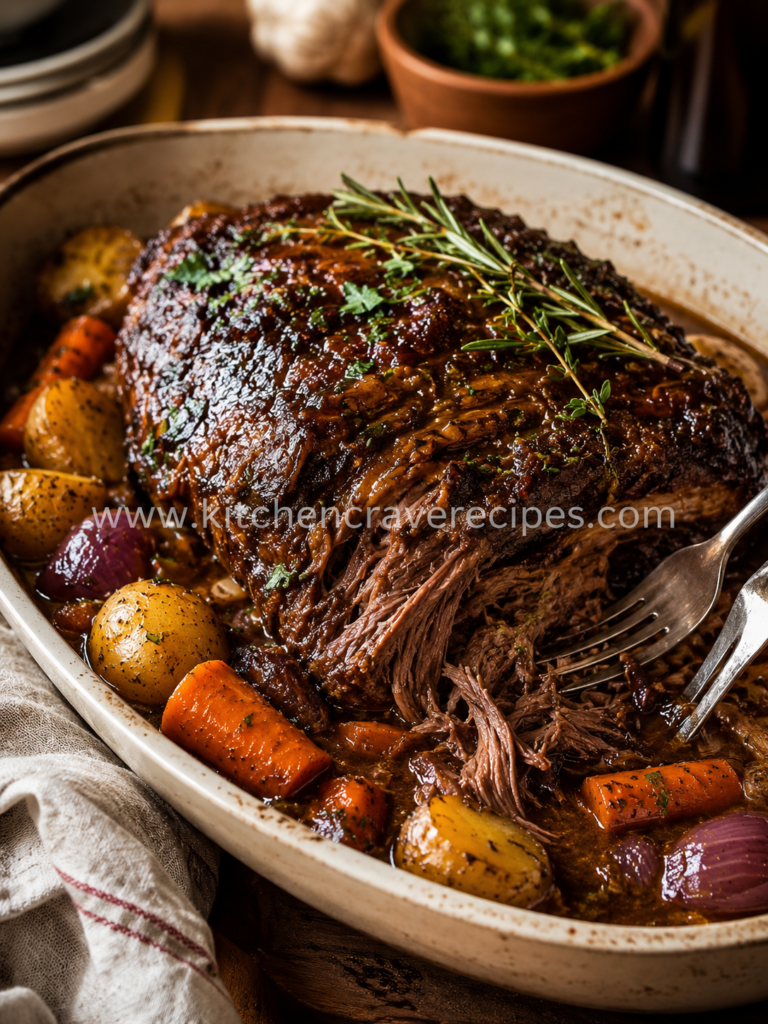
slow cooked balsamic beef roast — and the difference is remarkable. The photo captures it perfectly: a deeply lacquered, mahogany-glazed beef roast resting in a rustic wooden serving bowl, surrounded by baby potatoes, thick-cut carrots, and wedges of red onion, all bathed in a glossy, amber balsamic braising jus. A gold fork is just beginning to pull apart the meat, with fresh rosemary sprigs and chopped thyme scattered across the top.
Balsamic vinegar is the ingredient that transforms this roast from a standard braise into something genuinely memorable. As it simmers low and slow throughout the cook, the vinegar's natural sugars caramelize into the braising liquid, creating a sauce that is simultaneously tangy, sweet, and savory — rich enough to spoon over everything on the plate.
Fifteen minutes of prep and six hours of patient, gentle simmering deliver a centerpiece dinner that feels like it required your entire day but actually required very little of you at all.
Recipe Quick Info
| Detail |
Info |
| Prep Time |
15 minutes |
| Cook Time |
6 hours (LOW) or 3–4 hours (HIGH) |
| Total Time |
6 hours 15 minutes |
| Servings |
6 |
| Cuisine |
American / Italian-Inspired |
| Course |
Main Course / Dinner |
| Cooking Method |
Simmering (Slow Cooker) |
| Calories |
~430 per serving |
| Difficulty |
Easy |
Why You'll Love This Recipe
- The balsamic glaze is unlike any standard pot roast. The vinegar reduces during simmering into a glossy, lacquer-like sauce that coats the beef and vegetables in layers of tangy-sweet depth you simply don't get from broth alone.
- Completely hands-off after 15 minutes. Sear, build the sauce, pour it in — then the slow cooker handles everything from there while you go about your day with zero babysitting required.
- The vegetables cook right alongside the beef. Baby potatoes, carrots, and red onion wedges simmer in the same balsamic jus, absorbing the flavors and saving you an entire extra side dish.
- Impressive enough for a dinner party. Served in a rustic bowl with fresh rosemary and thyme — exactly like the photo — this looks and tastes far more restaurant-caliber than the effort it demands.
- Fall-apart tender every single time. Six hours of low, gentle simmering converts the chuck roast's collagen into gelatin, producing self-basting, melt-in-your-mouth beef without fail.
- Rich flavor from genuinely simple pantry ingredients. Balsamic vinegar, beef broth, garlic, and a few herbs carry this entire recipe — no specialty items or complicated sauce-making required.
- Leftovers get even better overnight. Like all long-braised meats, this slow cooked balsamic beef roast deepens in flavor after a night in the refrigerator as the jus continues to penetrate every fiber.
Ingredients
For the Beef Roast
- 3–4 lbs boneless beef chuck roast
- 1½ teaspoons kosher salt
- 1 teaspoon freshly ground black pepper
- 1 teaspoon garlic powder
- 1 teaspoon smoked paprika
- 2 tablespoons olive oil (for searing)
For the Balsamic Braising Liquid
- ½ cup balsamic vinegar (use a mid-quality vinegar — not the cheapest, not aged sipping vinegar)
- 1 cup low-sodium beef broth
- 2 tablespoons Worcestershire sauce
- 2 tablespoons tomato paste
- 4 garlic cloves, smashed
- 1 tablespoon brown sugar (balances the balsamic's acidity)
- 1 teaspoon dried thyme
- 1 teaspoon dried rosemary
Vegetables (as shown in photo)
- 1 lb baby yellow potatoes, left whole (as shown resting around the roast)
- 3 medium carrots, cut into 2-inch pieces
- 1 large red onion, cut into thick wedges (visible in the bowl alongside the beef)
Fresh Herb Garnish (as shown in photo)
- 2 sprigs fresh rosemary
- 1 tablespoon fresh thyme leaves, roughly chopped
- 1 tablespoon fresh flat-leaf parsley, finely chopped
Optional Add-Ins
- 1 tablespoon Dijon mustard (whisked into the braising liquid for extra complexity)
- ½ teaspoon crushed red pepper flakes
- 1 tablespoon honey (in place of brown sugar for a lighter sweetness)
Substitution Guide
| Original Ingredient |
Substitution |
Notes |
| Chuck roast |
Bottom round or brisket |
Brisket needs full 8 hours on LOW |
| Balsamic vinegar |
Red wine vinegar + 1 tsp honey |
Less complex but similar sweet-acid balance |
| Baby yellow potatoes |
Yukon Gold potatoes, quartered |
Cut slightly larger — they soften fast |
| Worcestershire sauce |
Coconut aminos |
Use for gluten-free or soy-free households |
| Brown sugar |
Honey or maple syrup |
Both integrate smoothly into the braising liquid |
| Red onion |
Yellow onion (2 medium) |
Milder sweetness; holds shape equally well |
Kitchen Tools Needed
- 6-quart slow cooker — essential for the simmering method; needed to fit the roast and vegetables comfortably
- Large cast-iron skillet or heavy-bottomed pan (for searing before simmering)
- Tongs
- Small whisk or fork (for mixing the braising liquid)
- Measuring cups and spoons
- Sharp chef's knife and cutting board
- Ladle (for spooning the jus over the finished roast)
- Meat thermometer (to confirm safe internal temperature)
- Two forks (for shredding or slicing the finished beef)
How to Make Slow Cooked Balsamic Beef Roast Step by Step
Step 1: Season and Sear the Chuck Roast
Pat the chuck roast thoroughly dry with paper towels — moisture on the surface prevents proper browning. Combine the salt, pepper, garlic powder, and smoked paprika in a small bowl and rub the blend firmly into every surface of the roast. Heat the olive oil in a large cast-iron skillet over medium-high heat until shimmering. Place the roast in the skillet and sear undisturbed for 3–4 minutes per side until a deeply mahogany crust forms — the meat should release naturally from the pan when the crust has properly developed.
💡 Embedded Tip: Sear the short sides of the roast for 1–2 minutes each as well. This seals flavor-building browning on every surface rather than just the flat top and bottom, which pays off enormously in the finished braising jus's depth.
Step 2: Build the Balsamic Braising Sauce
While the roast rests after searing, whisk together the balsamic vinegar, beef broth, Worcestershire sauce, tomato paste, brown sugar, dried thyme, and dried rosemary in a measuring cup or small bowl until the tomato paste is fully dissolved. Taste the liquid — it should be noticeably tangy, savory, and slightly sweet before it goes into the slow cooker. This is your baseline flavor, and it will concentrate and deepen considerably during the long simmering process.
Step 3: Layer the Slow Cooker
Place the baby potatoes, carrot pieces, and red onion wedges in the bottom of the slow cooker insert in an even layer. Scatter the smashed garlic cloves across the vegetables. Nestle the seared chuck roast directly on top of the vegetable bed — resting on but not submerged in the vegetables keeps it slightly elevated so the bottom braises while the top slowly bastes in the rising steam.
Step 4: Add the Braising Liquid and Start Simmering
Pour the balsamic braising liquid over the roast and vegetables. The liquid should come about halfway up the sides of the roast — add an additional splash of beef broth if needed to reach this level. Secure the lid on the slow cooker and set it to
LOW for 6 hours or HIGH for 3–4 hours.
Low and slow is strongly preferred for this cut. At LOW, the cooker maintains approximately 190–200°F, and the gentle, sustained simmering allows the balsamic's sugars to caramelize gradually into the sauce and the collagen in the chuck to fully convert into gelatin. The result is silk-tender beef in a rich, lacquered jus rather than just cooked meat in liquid.
💡 Embedded Tip — Simmering Method: The slow cooker on HIGH can tip close to a rolling boil near the heating element on some models, which tightens muscle protein fibers rather than gently releasing them. If your cooker runs hot or you notice vigorous bubbling rather than lazy, small simmers when you check it at the 2-hour mark, switch to LOW for the remainder. Proper simmering means small, occasional bubbles at the surface — not a choppy, active boil.
Step 5: Check Doneness and Rest
At the 6-hour mark on LOW (or 3–4 hours on HIGH), insert a meat thermometer into the thickest part of the roast. Per
USDA safe minimum internal temperature guidelines, beef roasts must reach
145°F to be safe — but for genuine fork-tender, pull-apart texture with this cut, you want
195–205°F, which is the range at which connective tissue has fully broken down. If a fork slides in with no resistance and the meat begins separating along its natural grain lines, it's ready. Turn off the slow cooker and let the roast rest in the liquid with the lid on for 10 minutes before serving.
Step 6: Garnish and Serve
Carefully transfer the roast and vegetables to a rustic serving bowl or platter — a wooden bowl lined with the braising jus, as shown in the photo, works beautifully. Ladle a generous amount of the balsamic jus over the entire surface. Lay fresh rosemary sprigs across the top of the roast and scatter chopped thyme and parsley over everything. The fresh herbs aren't just garnish — their bright, grassy aroma contrasts the rich, deep sauce and signals freshness in a dish that's been cooking for hours.
Pro Tips for Perfect Slow Cooked Balsamic Beef Roast
- Choose a well-marbled chuck roast. Look for visible white fat running through the muscle when selecting your roast — the more marbling, the richer and more tender your finished slow cooked balsamic beef roast will be. A lean-looking roast is a warning sign for dryness regardless of how long it simmers.
- Use mid-quality balsamic vinegar — not the cheapest. Budget balsamic tends to be thinner and more harshly acidic, which doesn't round out properly during long simmering. A mid-priced bottle (around $8–12) delivers the right balance of acidity and natural sweetness that makes the jus so distinctive.
- Simmering method tip — don't let it boil. True simmering is characterized by small, infrequent bubbles rising lazily from the bottom — not the vigorous churning of a boil. A boiling slow cooker on HIGH for 6 hours results in toughened, stringy meat. If the liquid is bubbling aggressively when you check, reduce to LOW immediately.
- Deglaze the searing skillet into the braising liquid. After removing the seared roast, add ¼ cup of the measured beef broth to the still-hot skillet and scrape up the fond (the dark browned bits) with a wooden spoon. Pour this into the braising liquid before adding it to the slow cooker — those fond-scraped bits are concentrated flavor that would otherwise be lost.
- Let the jus reduce before serving if it seems thin. After the cook time, if the braising liquid looks thin rather than glossy, ladle it into a small saucepan, bring it to a gentle simmer over medium heat, and reduce for 5–8 minutes until it coats a spoon. Pour this reduced jus back over the roast for the presentation you see in the photo.
Common Mistakes to Avoid
1. Using too lean a cut of beef.
Eye of round and sirloin don't have enough connective tissue or fat to benefit from long, slow simmering — they turn dry and mealy well before the 6-hour mark. Chuck roast, brisket, or short ribs are the correct cuts for this cooking method.
2. Letting the slow cooker boil instead of simmer. (Simmering method-specific)
Aggressive boiling throughout a 6-hour cook seizes and toughens the muscle proteins that simmering is meant to gently relax. Check the cooker at the 2-hour mark: if the liquid is bubbling actively rather than showing slow, small surface movements, switch to LOW immediately and don't use HIGH again.
3. Adding all the liquid before tasting the braising sauce.
The balsamic braising liquid is the soul of this roast. A quick taste before it goes into the slow cooker lets you catch an imbalance — too sharp, too sweet, or too flat — while you can still adjust. Once it's in the cooker and cooking for 6 hours, you can't meaningfully correct it.
4. Skipping the sear to save time.
Searing adds only 10 minutes but creates the dark, Maillard-browned crust that becomes the flavor backbone of the entire braising jus as it dissolves during simmering. An unseared roast produces a noticeably paler, thinner-tasting sauce.
5. Submerging the roast completely in liquid.
When the roast is fully submerged, the top surface steams rather than braises, and the meat can take on a boiled texture. Resting it on the vegetable bed with liquid reaching only halfway up creates the correct braising environment.
6. Lifting the lid repeatedly during simmering.
Each lid lift during slow cooker simmering adds 20–30 minutes to the effective cook time as accumulated heat escapes. Trust the cooker and check only at the designated time markers.
7. Serving without resting.
A 10-minute rest in the liquid after the heat is turned off allows the meat's internal juices to redistribute. Slicing or shredding immediately causes those juices to run out onto the serving dish rather than staying inside each piece of beef.
Variations
Healthy
Swap the brown sugar for a tablespoon of pure maple syrup, which has a slightly lower glycemic index and integrates smoothly into the balsamic braising liquid. Add 2 cups of chopped kale or spinach to the slow cooker in the last 30 minutes of simmering — the leafy greens wilt into the jus and add fiber, iron, and a color contrast against the dark, glossy sauce.
Vegetarian
This variation requires a completely different protein base — substitute two 15-oz cans of drained cannellini beans plus 4 large portobello mushroom caps, halved, for the chuck roast. Use vegetable broth in place of beef broth and reduce the balsamic vinegar to 3 tablespoons. Cook on LOW for 4 hours; the beans absorb the balsamic beautifully and the mushrooms develop a deeply savory, meaty quality without any animal protein.
Spicy
Add 1 tablespoon of sriracha and ½ teaspoon of cayenne pepper to the braising liquid before pouring it over the roast. The heat complements the balsamic's sweetness in a way that's noticeable but not overwhelming — the acidity tempers the spice so neither flavor dominates. Increase the crushed red pepper to 1 full teaspoon for a genuinely bold, fiery version.
Gluten-Free
This recipe is nearly gluten-free as written — simply confirm that your Worcestershire sauce is labeled gluten-free (some brands contain barley malt). Swap to a certified GF Worcestershire or substitute coconut aminos in equal measure. All other ingredients in this recipe are naturally gluten-free; no structural changes to the recipe are required.
Low-Carb / Keto
Replace the baby potatoes with large-cut turnips or radish halves, which absorb the balsamic braising jus well and lose their sharp raw flavor after 6 hours of simmering, taking on a mild, slightly sweet character. Omit the brown sugar entirely and use 1 tablespoon of erythritol or monk fruit sweetener to balance the balsamic's acidity. The carb count drops significantly while the rich, glossy braising sauce remains unchanged.
What to Serve With This Slow Cooked Balsamic Beef Roast
- Creamy mashed potatoes — if you skipped the in-pot potatoes, mashed potatoes are the natural vehicle for the balsamic jus. Try Best Slow Cooker Beef Roast – 5-Ingredient Recipe for the ideal pairing.
- Crusty artisan bread or sourdough — essential for mopping the glossy balsamic braising liquid from the bowl.
- Simple arugula salad with lemon vinaigrette — the peppery bitterness of arugula is a classic counterpoint to rich, slow-braised beef.
- Roasted asparagus or green beans — bright, lightly charred vegetables cut through the richness of the jus beautifully.
- Creamy polenta — a natural Italian-inspired pairing that complements the balsamic flavor profile of the roast and soaks up the sauce elegantly.
- Egg noodles or pappardelle pasta — wide, flat noodles tossed in the braising jus turn this into a luxurious pasta course alongside the sliced beef.
- Steamed broccoli or broccolini — simple, fast, and a healthy green counterpart that takes no additional effort on a slow cooker dinner night. Pair with Best Slow Cooker Beef Roast – 5-Ingredient Recipe for a restaurant-quality plate.
Storage Instructions
Refrigerator
Transfer the sliced or shredded beef and all braising liquid together into an airtight container — storing them separately causes the meat to dry out within hours. Refrigerate for up to
4 days. The balsamic jus will gel when cold due to the gelatin released from the collagen during simmering, which is completely normal and a sign of a well-made braise.
Freezer
Portion the beef and braising liquid together into freezer-safe containers or heavy-duty zip-top bags. Remove as much air as possible before sealing and freeze for up to
3 months. Thaw overnight in the refrigerator before reheating — never thaw at room temperature for more than 2 hours.
Shelf Life Summary
| Storage Method |
Duration |
| Refrigerator (airtight with jus) |
Up to 4 days |
| Freezer (portioned with jus) |
Up to 3 months |
| Room temperature |
2 hours maximum |
Reheating Instructions
Oven
Preheat to
325°F. Place the beef and jus in an oven-safe dish, cover tightly with foil, and heat for 20–25 minutes until warmed through. The covered foil prevents moisture loss and keeps the balsamic jus from caramelizing too fast on the surface during reheating.
Microwave
Transfer a single portion along with a spoonful of jus to a microwave-safe bowl. Cover loosely with a damp paper towel and heat on medium power (70%) in 60-second intervals, stirring between each, until the internal temperature reaches
165°F. Medium power prevents the edges from overcooking before the center is fully warm.
Stovetop
Add the beef and braising liquid to a small saucepan over medium-low heat. Stir occasionally and warm for 8–10 minutes until the jus is loose and gently simmering at the edges — look for small, lazy bubbles rather than a hard boil, which can tighten the meat fibers during reheating.
For complete reheating safety guidelines, refer to the
USDA Food Safety and Inspection Service leftovers resource.
Nutrition Facts
| Nutrient |
Per Serving (approx.) |
| Calories |
~430 |
| Total Fat |
21g |
| Saturated Fat |
8g |
| Protein |
40g |
| Total Carbohydrates |
22g |
| Dietary Fiber |
3g |
| Sugars |
8g |
| Sodium |
540mg |
Nutrition Disclaimer: Nutrition values are estimates calculated using standard ingredient databases and will vary based on specific brands, exact weights, cut of beef, and any substitutions made. These figures are for general informational purposes only and are not a substitute for personalized dietary guidance from a registered dietitian or qualified healthcare provider.
Frequently Asked Questions
What makes balsamic vinegar work so well in a beef roast?
Balsamic vinegar brings three distinct functional properties: acidity that tenderizes the meat's surface proteins, natural grape sugars that caramelize during long simmering into a glossy sauce, and complex flavor compounds that add depth no standard broth-only braise can replicate. The sweet-tangy balance is what sets this slow cooked balsamic beef roast apart from a classic pot roast.
What's the best cut of beef for this recipe?
Boneless chuck roast is the ideal choice — it has the right balance of fat and connective tissue that fully breaks down after 6 hours of simmering into gelatin, producing melt-tender beef and a naturally rich sauce. Brisket and bone-in short ribs are excellent alternatives, though brisket benefits from an extra hour of cook time.
Can I make this in an Instant Pot instead of a slow cooker?
Yes — use the Sauté function to sear the roast, add all ingredients, and pressure cook on HIGH for 65–70 minutes with a 15-minute natural release. The result is good but subtly different: pressure cooking doesn't allow the same gradual caramelization of the balsamic that slow simmering produces. The sauce will be thinner and may need a few minutes of reduction on the Sauté function before serving.
Why did my braising sauce taste too sharp or sour?
Two likely causes: either the balsamic vinegar was very low quality (thin, harsh, and acidic without natural sweetness), or the brown sugar was omitted or reduced too aggressively. To fix a sharp sauce after cooking, stir in an additional teaspoon of brown sugar or honey and let it dissolve into the hot liquid for 5 minutes before serving. Taste and repeat if needed.
Can I cook this on HIGH for the full time if I'm short on time?
You can cook on HIGH for 3–4 hours and get a good result, but LOW for 6 hours is meaningfully better. LOW's gentler temperature allows a true simmering environment that more fully breaks down the connective tissue and gives the balsamic more time to caramelize into the sauce. Use HIGH only when time is a genuine constraint.
How do I thicken the braising jus into a proper sauce?
Ladle the jus into a small saucepan and bring it to a gentle simmer over medium heat. Cook uncovered for 6–10 minutes, stirring occasionally, until it reduces and thickens enough to coat the back of a spoon. Alternatively, whisk 1 tablespoon of cornstarch with 2 tablespoons of cold water, add to the simmering jus, and stir for 2 minutes until thickened.
Do I have to sear the roast before slow cooking?
Technically no, but practically yes if you care about flavor. The Maillard reaction from searing creates hundreds of flavor compounds that simmering cannot produce — it's what gives the finished sauce its deep, complex character. Skipping the sear saves 10 minutes but noticeably flattens the flavor of both the meat and the jus.
Can I add wine to the braising liquid?
Yes — substitute ¼ cup of the beef broth with ¼ cup of dry red wine (such as Cabernet Sauvignon or Merlot). The tannins in red wine complement the balsamic vinegar's acidity and add another dimension of complexity to the braising liquid. Add it along with the other liquids before pouring everything into the slow cooker.
How do I know if my slow cooker is simmering properly or boiling?
Proper simmering shows as occasional small bubbles breaking the surface lazily — you might see a few bubbles at a time, slowly rising from the bottom of the insert. Boiling produces a constant, vigorous roll of bubbles across the entire surface. If you lift the lid at the 2-hour mark and see boiling, switch to LOW immediately.
Can I make this slow cooked balsamic beef roast completely ahead for a dinner party?
Yes — this dish reheats exceptionally well and actually tastes better the day after cooking as the balsamic jus fully permeates the meat. Cook the day before, refrigerate in the braising liquid, and reheat covered in a 325°F oven for 30–35 minutes before serving. Garnish with fresh herbs immediately before bringing it to the table.
Why are fresh herbs added at the end instead of during cooking?
Fresh herbs like rosemary, thyme, and parsley lose their bright color and most of their volatile aromatic oils during 6 hours of simmering — they turn drab and bitter. Adding dried herbs during cooking provides sustained background flavor, while fresh herb garnish at serving adds a visually striking green contrast and a burst of bright, grassy aroma that makes the finished dish feel alive and just-made.
Expert Chef Tips
- Buy chuck roast with visible marbling throughout. At the butcher counter or meat case, look for consistent white fat streaking through the muscle rather than concentrated around the edges only. Interior marbling bastes the meat from within during simmering, which is fundamentally different from edge fat that merely renders off into the liquid.
- Use the fond from the skillet, every time. After searing the roast and removing it, that dark layer stuck to the cast-iron skillet is concentrated, Maillard-browned beef flavor. Deglaze with a splash of broth, scrape it clean with a wooden spoon, and add every drop to the braising liquid. It's one of the highest-impact flavor steps in the entire recipe and takes under 60 seconds.
- Salt the roast at least 30 minutes before searing, or up to overnight. Salting in advance draws surface moisture out, which the meat then reabsorbs along with the salt — a simple dry brine that seasons the interior rather than just the surface. Overnight dry brining in the refrigerator produces the most deeply seasoned finished roast.
- Add the fresh rosemary and thyme stems during simmering, then garnish with the fresh leaves at serving. Whole herb stems (not the chopped leaves) placed in the braising liquid during cooking release steady background flavor without turning bitter. Pull the stems out before serving and replace them with the fresh, chopped herb garnish you see in the photo for maximum visual and aromatic impact.
- Reduce a portion of the jus separately if you want a proper glaze. Ladle off about ½ cup of the finished braising liquid into a small saucepan and reduce it by half over medium heat — 5–6 minutes — until it becomes thick and syrupy. Brush or spoon this glaze directly over the roast just before serving for the deeply lacquered, mirror-like surface visible in the photo.
Recipe Summary
This
slow cooked balsamic beef roast combines a seared, well-seasoned chuck roast with a tangy-sweet balsamic braising liquid and a bed of baby potatoes, carrots, and red onion — all simmered together on LOW for 6 hours until the beef is fall-apart tender and the sauce has concentrated into a rich, glossy jus. The key steps are searing for flavor depth, maintaining a true simmer rather than a boil throughout the cook, and finishing with fresh rosemary, thyme, and parsley for the bright, herb-forward presentation shown in the photo. Serve directly from a rustic bowl with the jus spooned generously over everything.
Conclusion
A dinner that looks this impressive and tastes this deeply flavored — mahogany-glazed beef, silky balsamic jus, vegetables cooked right alongside — shouldn't be something that requires hours of active effort. That's precisely what makes this
slow cooked balsamic beef roast so satisfying to pull from the cooker at the end of a busy day: the slow cooker did all the real work, and all you have to do is garnish it beautifully and bring it to the table. Make it once, and it will find a permanent place in your dinner rotation. Happy cooking.