Sheet Pan Supreme Pizza: Best 12-Slice Foolproof Recipe


Introduction
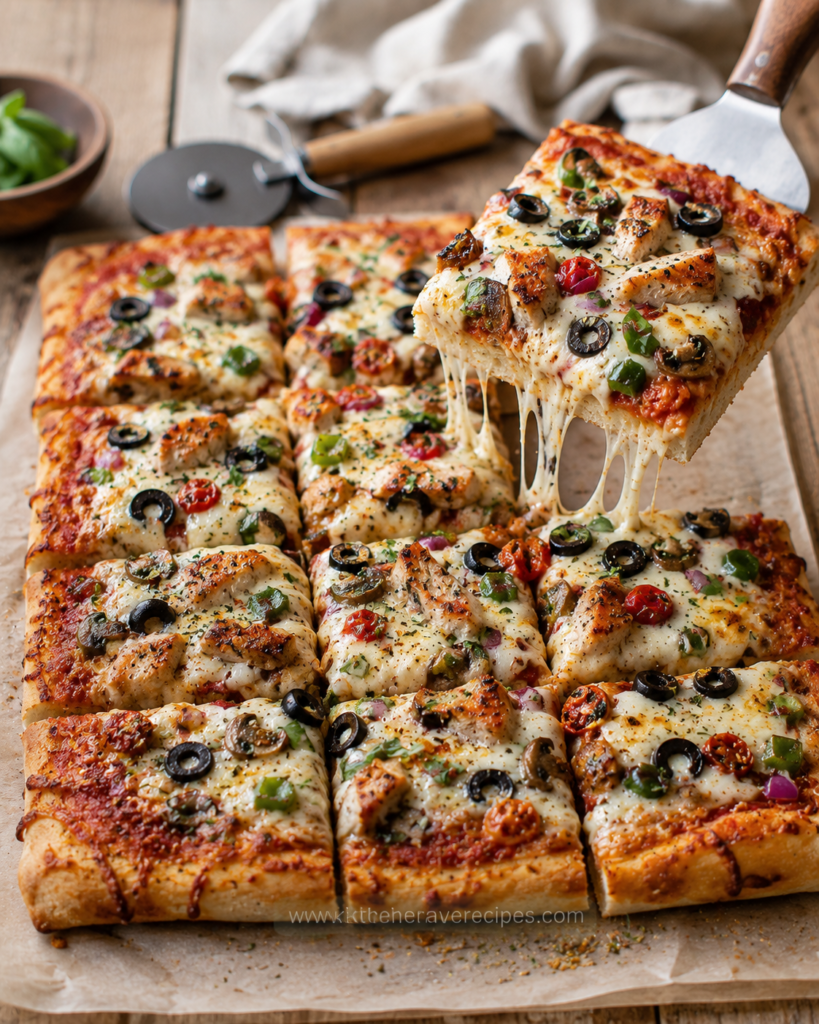
Friday nights, game days, family dinners — there’s one recipe that handles all of them without any stress, and this sheet pan supreme pizza is it. Pressed into an oiled sheet pan and baked until the crust turns golden and almost focaccia-like on the bottom, loaded with bubbling mozzarella, tender mushrooms, green bell pepper, red onion, cherry tomatoes, and sliced black olives, this pizza is the kind of thing people hover over before it even makes it to the table. One square slice has satisfying pull-apart cheese and a crust that crisps at the edges while staying pillowy in the center.
What makes the sheet pan method genuinely better than a standard round pizza for a home cook is the forgiveness. No stretching a round, no worrying about a pizza stone, no awkward peel transfer. You press the dough into the pan, let it puff, pile on the toppings, and bake. The sheet pan supreme pizza feeds 12 people from a single pan, making it the most practical large-format pizza you can make at home without any specialized equipment.
Recipe Quick Info Table
| Detail | Info |
|---|---|
| Prep Time | 25 minutes (includes 15-min dough rest) |
| Cook Time | 22 minutes |
| Total Time | 47 minutes |
| Servings | 12 squares |
| Cuisine | American / Italian-Inspired |
| Course | Main Course / Dinner |
| Calories | ~340 per slice |
| Difficulty | Standard |
Why You’ll Love This Recipe
- Feeds a crowd from one pan. Twelve generous square slices from a single 18×13-inch sheet pan — no second batch, no second pan, no pizza delivery math required.
- Thick, crispy-bottomed crust without a pizza stone. The oiled sheet pan does what a stone does at home, creating a golden, almost-fried bottom crust with a soft, airy interior that no thin-crust method can match.
- Loaded with real supreme toppings. Mushrooms, green bell pepper, red onion, cherry tomatoes, and sliced black olives — every topping visible in this pizza earns its spot and gives you something different in every bite.
- Stretchy, genuinely pull-apart mozzarella. A generous layer of whole-milk mozzarella melts into long, dramatic cheese pulls that make every slice feel completely indulgent.
- Works with store-bought or homemade dough. The recipe gives you a simple from-scratch dough, but a 16-oz ball of store-bought pizza dough works perfectly and cuts the prep time to under 10 minutes.
- No specialized tools needed. A standard rimmed half-sheet pan, a bowl, and a spatula are all the equipment required — no pizza stone, no peel, no high-temperature specialty oven.
- Reheats better than any round pizza. The thick crust holds moisture well, and the square slices reheat in a skillet or oven back to their original crispy-bottom texture without becoming leathery or soggy.
Ingredients
For the Pizza Dough
- 2¼ teaspoons active dry yeast (one standard packet)
- 1 cup warm water (110°F)
- 1 teaspoon granulated sugar
- 2¾ cups all-purpose flour, plus more for kneading
- 1 teaspoon kosher salt
- 2 tablespoons extra-virgin olive oil, plus more for the pan
For the Pizza Sauce
- 1 cup canned crushed tomatoes (San Marzano style preferred)
- 2 garlic cloves, finely grated
- 1 tablespoon olive oil
- ½ teaspoon dried oregano
- ½ teaspoon dried basil
- ¼ teaspoon kosher salt
- ¼ teaspoon red pepper flakes
- ½ teaspoon granulated sugar
For the Toppings (as shown in photo)
- 2 cups whole-milk low-moisture mozzarella, shredded (not fresh mozzarella — see tip below)
- 1 cup cremini or white button mushrooms, thinly sliced
- ¾ cup green bell pepper, diced
- ½ cup red onion, thinly sliced
- ½ cup cherry tomatoes, halved
- ½ cup sliced black olives (from a can, drained well)
- 1 teaspoon dried Italian seasoning
- 1 tablespoon olive oil, for drizzling over toppings
- 1 tablespoon fresh flat-leaf parsley, finely chopped (for finishing)
- Freshly ground black pepper, to taste
Optional Add-Ins
- ½ cup cooked Italian sausage, crumbled (for a meat version)
- ¼ cup sliced pepperoni
- Pinch of dried chili flakes on top before baking
Ingredient Substitution Table
| Original Ingredient | Best Substitute | Notes |
|---|---|---|
| All-purpose flour | Bread flour | Bread flour has more gluten, giving a chewier, more structured crust |
| Whole-milk mozzarella | Part-skim mozzarella | Melts well but is slightly less creamy and produces less stretch |
| Cremini mushrooms | Portobello mushrooms, diced | Deeper, earthier flavor; dice small to match the other topping sizes |
| Green bell pepper | Red or yellow bell pepper | Sweeter flavor; color contrast looks beautiful on a loaded supreme pizza |
| Black olives | Kalamata olives, halved | Stronger, brinier flavor — use slightly less to avoid overpowering |
| Crushed tomatoes | Tomato passata | Smoother texture; use the same quantity without draining |
Kitchen Tools Needed
- 18×13-inch rimmed half-sheet pan (standard US half-sheet pan)
- Stand mixer with dough hook, OR large mixing bowl and hands
- Small saucepan or bowl (for sauce)
- Ladle or large spoon (for spreading sauce)
- Cheese grater or box grater
- Pizza cutter or sharp chef’s knife
- Pastry brush (for oiling the pan)
- Instant-read thermometer (for proofing water temp)
- Plastic wrap or clean kitchen towel (for resting dough)
Step-by-Step Instructions
Step 1: Activate the Yeast
Combine the warm water (110°F — warm to the touch, not hot; hot water kills yeast) and granulated sugar in a large bowl or the bowl of a stand mixer. Sprinkle the active dry yeast over the top and let it sit for 5–7 minutes without stirring. When the surface turns foamy and fragrant, the yeast is active and ready to use. If nothing happens after 10 minutes, the yeast is dead or the water was the wrong temperature — start over with a fresh packet.
Embedded Tip: Use a thermometer the first few times you proof yeast. 110°F is the reliable sweet spot. Water that feels comfortably warm on your wrist is usually close, but a thermometer removes all uncertainty.
Step 2: Make and Rest the Dough
Add the flour, salt, and olive oil to the activated yeast mixture. Mix with a dough hook on medium speed for 6–7 minutes, or knead by hand on a lightly floured surface for 8–10 minutes, until the dough is smooth, slightly tacky, and springs back slowly when you poke it. Place the dough in a lightly oiled bowl, cover with plastic wrap or a clean towel, and let it rest for 15 minutes at room temperature. This is a quick rest, not a full rise — just long enough to relax the gluten so the dough stretches into the pan without snapping back.
Step 3: Make the Pizza Sauce
While the dough rests, combine the crushed tomatoes, grated garlic, olive oil, oregano, basil, salt, red pepper flakes, and sugar in a small bowl. Stir until fully combined — no cooking required. A raw-mixed sauce using quality crushed tomatoes preserves a brighter, more vibrant flavor than a cooked-down sauce and works perfectly for the short bake time of a sheet pan pizza.
Step 4: Oil the Pan and Press the Dough
Preheat your oven to 450°F. Pour 3 tablespoons of olive oil into the sheet pan and spread it across the entire surface including the sides — this is what creates the crispy, almost fried bottom crust. Transfer the dough to the oiled pan and press it outward from the center toward the edges using your fingertips. If the dough resists and springs back, cover it loosely and wait 5 minutes for the gluten to relax further before continuing. Work toward the corners and aim for a roughly even ½-inch thickness across the whole pan.
Embedded Tip: Don’t fight the dough if it keeps snapping back. A 5-minute covered rest mid-press is the professional solution — the gluten relaxes and the dough becomes much more cooperative without any additional effort.
Step 5: Sauce, Cheese, and Toppings
Ladle the pizza sauce over the pressed dough and spread it evenly using the back of a spoon, leaving a ½-inch border around the edges for the crust. Scatter the shredded mozzarella in an even layer over the sauce — use all of it. Distribute the sliced mushrooms, diced green bell pepper, red onion, halved cherry tomatoes, and drained black olives evenly across the surface. Drizzle the tablespoon of olive oil over the toppings, sprinkle with Italian seasoning and black pepper, and make sure the vegetables are spread to the very edges so every corner slice gets full topping coverage.
Step 6: Bake the Sheet Pan Supreme Pizza
Place the pan on the lowest rack of your fully preheated 450°F oven. Bake for 20–22 minutes, until the mozzarella is bubbling and golden in spots, the edges of the crust are deep golden brown, and the bottom crust (which you can check by carefully lifting one corner with a spatula) is crisp and set. The internal temperature of the crust center should register at least 200°F. For food safety with any meat add-ins, the USDA recommends cooking ground meat toppings to 160°F before adding them to the pizza.
Step 7: Rest, Garnish, and Cut
Remove the pan from the oven and let the pizza rest in the pan for 5 minutes before cutting — this allows the cheese to set slightly so slices hold together cleanly rather than sliding apart. Scatter fresh chopped parsley over the surface. Use a pizza cutter or large sharp knife to cut the pizza into 12 equal squares directly in the pan. Serve immediately from the pan or transfer to a cutting board for plating.
Pro Tips
- Oil the pan generously — more than feels right. Three tablespoons sounds like a lot, but it’s what creates that bakery-style crispy-bottom crust. Too little oil and the dough steams instead of frying against the pan surface.
- Use low-moisture mozzarella, never fresh. Fresh mozzarella contains too much water and will make your sheet pan supreme pizza soggy. Low-moisture whole-milk mozzarella melts cleanly, stretches dramatically, and stays in place on the crust.
- Pre-cook wet vegetables if using extras. Mushrooms, zucchini, and bell peppers all release water in the oven. The amounts in this recipe are calibrated to stay dry, but if you add extra mushrooms or switch to a very watery vegetable, sauté them briefly first.
- Bake on the lowest oven rack. The lowest rack position puts the bottom of the pan closest to the heating element, which is the key to a crispy, golden undercarriage. The middle rack produces a softer bottom that never fully crisps.
- Let it rest 5 minutes before cutting. Hot cheese is liquid. Five minutes of rest solidifies it just enough to cut clean squares that hold together on the spatula instead of folding and sliding.
Common Mistakes to Avoid
1. Under-oiling the sheet pan.
Insufficient oil means the dough sticks and the bottom never crisps — you get steamed, pale dough instead of a golden, crunchy base.
Fix: Use a full 3 tablespoons of olive oil spread across every inch of the pan, including the sides.
2. Using fresh mozzarella instead of low-moisture.
Fresh mozzarella is packed in water. It releases all that liquid during baking, turning the sauce into a puddle and leaving the crust soggy.
Fix: Always use low-moisture, whole-milk shredded mozzarella for sheet pan pizza. Shred it yourself for the cleanest melt.
3. Adding toppings to a cold oven.
Sliding the pan into a 450°F oven that hasn’t fully preheated means the pizza spends extra time in low heat, which cooks the toppings before the crust crisps.
Fix: Always let the oven fully preheat for at least 20 minutes at 450°F before the pan goes in.
4. Spreading sauce to the edges.
Sauce touching the sides of the pan creates steam that softens the very crust edges you want crispy and browned.
Fix: Leave a consistent ½-inch border of bare dough around all four edges — it puffs and browns beautifully on its own.
5. Overloading with too many toppings.
A generously topped pizza is great; an overloaded one is a soggy, undercooked mess where the dough never has a chance to set under the weight.
Fix: Follow the quantities listed. If you want to add meat, add it in place of, not in addition to, some of the vegetables.
6. Skipping the dough rest after pressing.
Pressing immediately into a fully shaped pizza without any rest produces a dense, tough crust because the gluten never had time to relax and the dough didn’t get even partially puffy.
Fix: After pressing the dough into the pan, let it rest uncovered for at least 10 minutes while you prep your toppings.
7. Cutting the pizza immediately out of the oven.
Cutting hot pizza straight from the oven drags liquid cheese across the surface and makes a messy, uneven cut that causes toppings to slide off.
Fix: Five minutes of rest is all you need — set a timer so you don’t skip this step.
Variations
Meat Lover’s Sheet Pan Version
Add ½ cup of cooked, crumbled Italian sausage and ¼ cup of sliced pepperoni to the topping layer before baking. Cook the sausage to 160°F before adding — don’t rely on the oven bake to cook raw meat on top of a pizza. The fat from both meats renders during baking and bastes the surrounding cheese, creating an even richer, more deeply browned surface.
Vegetarian Loaded Version
This recipe is already vegetarian as written, but you can push it further by adding ½ cup of roasted red peppers, a handful of baby spinach (added in the last 3 minutes of baking so it wilts but doesn’t burn), and a drizzle of balsamic glaze after the pizza comes out of the oven. The balsamic adds a sweet-acidic note that lifts all the vegetables and makes the whole pizza feel more complex.
Spicy Supreme Version
Swap the red pepper flakes in the sauce for 1 tablespoon of Calabrian chili paste, and scatter a thin layer of hot capicola or spicy pepperoni over the cheese before baking. Finish with a drizzle of hot honey straight from the oven — the sweet-heat combination against bubbling mozzarella is genuinely addictive and changes the whole personality of the pizza without a single technique change.
Gluten-Free Sheet Pan Pizza
Use a store-bought gluten-free pizza dough ball (most major grocery stores carry Bob’s Red Mill or similar brands). Press it into the well-oiled pan exactly as you would regular dough — it won’t stretch quite as far, so plan on a slightly smaller, thicker pizza. All toppings in this recipe are naturally gluten-free; just confirm your pizza sauce brand has no hidden gluten-containing additives.
Low-Carb / Cauliflower Crust Version
Replace the yeasted dough with a cauliflower crust base (a well-drained, baked cauliflower mixture pressed into the oiled pan). The cauliflower base is far more delicate than wheat dough, so reduce the oven temperature to 425°F and bake the crust alone for 15 minutes before adding sauce and toppings. Finish with 10–12 more minutes until the cheese is golden. Check out Mediterranean Grilled Chicken Rice Bowl in Best 30-Minute for a detailed step-by-step guide.
What to Serve With This Recipe
- A crisp Caesar salad — the bright, lemony dressing cuts through the richness of the mozzarella and gives the meal some fresh green contrast.
- Garlic bread or garlic knots — deeply on-brand for a pizza night; bake them in the oven while the pizza rests, using the residual heat.
- Sparkling water with lemon — keeps the palate clean between bites without competing with the savory toppings.
- A simple arugula salad with shaved Parmesan — the peppery greens wilt slightly if you pile them on the hot pizza, which makes a surprisingly good warm salad base.
- Marinara dipping sauce — a small ramekin of extra pizza sauce on the side for crust-dipping is always welcome, especially for kids at the table.
- Our Zucchini Ricotta Roll-Ups (Best Ever)-Easy 5-Ingredient— if you’re making dough from scratch anyway, knock out a double batch and use the second half for garlic knots while the pizza bakes.
- An ice-cold pitcher of lemonade or sparkling rosé — for a weekend dinner, either makes the whole meal feel like a proper occasion without any extra effort.
Storage Instructions
Refrigerator
Cool the pizza completely before storing — never refrigerate it while still hot, as the steam condenses inside the container and makes the crust soggy. Stack squares in an airtight container with parchment paper between layers to prevent sticking. Properly stored sheet pan supreme pizza keeps for up to 4 days in the refrigerator. The crust softens slightly from refrigeration, but reheating fully restores the crispy texture.
Freezer
Sheet pan pizza freezes exceptionally well. Wrap individual slices tightly in plastic wrap, then place in a zip-top freezer bag with the air pressed out. Label with the date and freeze for up to 2 months. Thaw in the refrigerator overnight before reheating — or reheat directly from frozen in the oven at 375°F for 12–15 minutes.
Shelf Life Summary
| Storage Method | Duration |
|---|---|
| Room temperature | 2 hours maximum |
| Refrigerator (airtight) | 4 days |
| Freezer (wrapped individually) | 2 months |
Reheating Instructions
Oven (Best Results — Restores the Crispy Bottom)
Preheat oven to 375°F. Place slices directly on the oven rack or on a sheet pan. Heat for 8–10 minutes until the cheese is bubbling and the crust bottom is crispy again. This method completely restores the texture and is worth the extra time whenever you have it.
Stovetop Skillet (Second-Best — Fastest Crispy Result)
Place slices in a cold non-stick or cast-iron skillet over medium-low heat. Cover the pan with a lid and heat for 4–5 minutes. The covered pan traps steam to melt the cheese while the dry skillet bottom re-crisps the crust. No oil needed. Per USDA food safety guidelines for leftovers, all reheated pizza should reach an internal temperature of 165°F before eating.
Microwave (Fastest — Softest Result)
Place one or two slices on a microwave-safe plate with a cup of water in the corner of the microwave. Heat on full power for 45–60 seconds. The cup of water creates steam that prevents the cheese from overheating and turning rubbery. The crust will be soft rather than crispy — acceptable for a quick lunch, but the skillet or oven method is better whenever time allows.
Nutrition Facts
| Nutrient | Per Slice (1 of 12) |
|---|---|
| Calories | ~340 |
| Total Fat | 14g |
| Saturated Fat | 5g |
| Cholesterol | 25mg |
| Sodium | 610mg |
| Total Carbohydrates | 42g |
| Dietary Fiber | 3g |
| Total Sugars | 4g |
| Protein | 13g |
Nutrition Disclaimer: Nutrition values are estimated using standard USDA nutritional data and a recipe analysis tool, based on the ingredients listed without optional add-ins. Actual values will vary depending on specific brands of cheese, sauce, and dough used, as well as any toppings added or substituted. These figures are for general informational purposes only and are not intended as medical or dietary advice. Consult a registered dietitian for personalized nutritional guidance.
Frequently Asked Questions
Can I use store-bought pizza dough for sheet pan supreme pizza?
Absolutely — a 16-oz ball of store-bought pizza dough works perfectly and is the most common shortcut home cooks use for this recipe. Let it come to room temperature for 20–30 minutes before pressing into the pan, which makes it significantly easier to stretch without springing back.
What size sheet pan do I need?
A standard 18×13-inch rimmed half-sheet pan is ideal and produces the 12-square pizza shown in the photo. A smaller 13×9-inch pan will work but produces a thicker pizza that needs a slightly longer bake time (add 3–5 minutes). Quarter-sheet pans are too small for this recipe as written.
How do I get the bottom crust crispy?
Three things together create the crispy bottom: generous olive oil in the pan (3 tablespoons minimum), a fully preheated 450°F oven, and baking on the lowest oven rack. Skip any one of these and the bottom will be pale and soft rather than golden and crisp.
Can I make the dough ahead of time?
Yes — the dough can be made up to 24 hours ahead and stored in the refrigerator in a lightly oiled covered bowl. Cold-fermented dough actually develops more complex flavor. Remove it from the refrigerator 30 minutes before pressing into the pan to bring it back to room temperature.
Why is my pizza crust raw in the center?
The most common cause is an oven that wasn’t fully preheated. A 450°F oven needs 20+ minutes to fully saturate the walls and floor of the oven with heat. The second common cause is too many wet toppings, which release moisture that steams the crust from above. Follow the listed topping quantities and bake on the lowest rack.
Can I make this sheet pan supreme pizza without yeast?
You can use a no-yeast dough made with self-rising flour and Greek yogurt — combine 2 cups of self-rising flour with 1 cup of plain Greek yogurt and mix until a dough forms. The texture will be denser and less airy than a yeasted dough, but it’s a workable option and comes together in under 5 minutes.
What’s the best cheese for sheet pan pizza?
Whole-milk low-moisture mozzarella, shredded fresh from a block, is the best choice. It melts evenly, stretches dramatically, and browns in the spots that make pizza look and taste great. Avoid pre-shredded bags if possible — the anti-caking coating reduces melt quality slightly.
Can I add meat toppings?
Yes — cooked Italian sausage and sliced pepperoni are the most natural fits for a supreme-style pizza. Always cook raw ground meat to 160°F before adding it to the pizza, as the bake time isn’t long enough to safely cook raw ground meat through on top of the pizza.
How do I cut sheet pan pizza into even squares?
Use a pizza cutter or a long chef’s knife and commit to straight lines rather than estimating as you go. For 12 equal squares, make 3 cuts lengthwise and 2 cuts across the width of the pan. Mark the cut lines lightly before pressing down fully — this makes it easier to correct before the cut is final.
Can I freeze unbaked sheet pan pizza?
Freezing assembled but unbaked pizza is possible but tricky — the dough can become gummy during thawing. A better approach is to par-bake the dough alone for 8 minutes at 450°F, cool it completely, add toppings, wrap tightly, and freeze. Bake directly from frozen at 400°F for 18–20 minutes when ready to serve.
Why does my mozzarella brown unevenly?
Uneven browning usually means the cheese wasn’t distributed in an even layer, or there were pockets of sauce moisture bubbling through. Use freshly shredded mozzarella spread evenly across the entire surface, and make sure the sauce layer beneath it is spread to roughly the same thickness throughout.
Expert Chef Tips
1. Pre-heat the sheet pan for an extra-crispy bottom.
Place the oiled sheet pan in the oven during preheating — a hot pan hitting 450°F creates an immediate sear on the dough when it goes in, mimicking what a pizza stone does. This technique takes exactly zero extra effort and produces noticeably crispier results than starting with a cold pan.
2. Shred your own mozzarella — every time.
Pre-shredded mozzarella is coated with potato starch or cellulose to prevent clumping in the bag. That coating also prevents clean melting in the oven. Shredding your own from a block takes two minutes and produces dramatically better stretch, browning, and overall cheese quality on the finished pizza.
3. Season your sauce to taste before it goes on the dough.
Raw pizza sauce can vary significantly in sweetness and acidity depending on the brand of crushed tomatoes you use. Always taste it and adjust — more sugar if it’s too acidic, a pinch more salt if it’s flat, a touch of olive oil if it feels thin. Seasoning at this stage is far easier than trying to fix a flat pizza after it’s baked.
4. Don’t crowd the toppings — spread them to the corners.
The most consistent complaint about homemade supreme pizza is that the center gets all the toppings and the corner slices are bare. Consciously spread every topping ingredient all the way to the edges and into the corners — those corner squares are often the most coveted for their extra-crispy crust, so they deserve full topping coverage.
5. Rotate the pan halfway through baking.
Home ovens have hot spots — areas that run hotter than the set temperature, which causes uneven browning. Rotating the pan 180 degrees at the halfway point of the bake (around 10–11 minutes) ensures the cheese browns evenly across the entire surface and the crust edges crisp uniformly.
Recipe Summary
This sheet pan supreme pizza produces 12 generous squares with a golden, crispy-bottomed crust, bubbling whole-milk mozzarella, and a full load of mushrooms, green bell pepper, red onion, cherry tomatoes, and black olives — all made in one pan in under 50 minutes. The homemade yeasted dough is straightforward, but store-bought dough works equally well if you’re short on time. It feeds a crowd, reheats beautifully for days, and delivers restaurant-quality results without any specialized pizza equipment.
Conclusion
Once you’ve made a sheet pan supreme pizza at home, ordering delivery for a group starts to feel like a lot of unnecessary expense for something you can do better yourself. The thick, golden-bottomed crust, the generously loaded toppings, the dramatic cheese pulls — it all comes together in a single pan with basic pantry ingredients and less than 50 minutes of your time. Make it for a Friday dinner, a game-day spread, or any night you want something genuinely satisfying on the table without a lot of fuss. Give it a try, and let us know in the comments how your version turned out!
Sheet Pan Supreme Pizza: Best 12-Slice Foolproof Recipe
Description
Friday nights, game days, family dinners — there's one recipe that handles all of them without any stress, and this sheet pan supreme pizza is it. Pressed into an oiled sheet pan and baked until the crust turns golden and almost focaccia-like on the bottom, loaded with bubbling mozzarella, tender mushrooms, green bell pepper, red onion, cherry tomatoes, and sliced black olives, this pizza is the kind of thing people hover over before it even makes it to the table. One square slice has satisfying pull-apart cheese and a crust that crisps at the edges while staying pillowy in the center.
Ingredients
Instructions
-
Step-by-Step Instructions
-
Step 1: Activate the Yeast
-
Combine the warm water (110°F — warm to the touch, not hot; hot water kills yeast) and granulated sugar in a large bowl or the bowl of a stand mixer. Sprinkle the active dry yeast over the top and let it sit for 5–7 minutes without stirring. When the surface turns foamy and fragrant, the yeast is active and ready to use. If nothing happens after 10 minutes, the yeast is dead or the water was the wrong temperature — start over with a fresh packet.
-
Embedded Tip: Use a thermometer the first few times you proof yeast. 110°F is the reliable sweet spot. Water that feels comfortably warm on your wrist is usually close, but a thermometer removes all uncertainty.
-
Step 2: Make and Rest the Dough
-
Add the flour, salt, and olive oil to the activated yeast mixture. Mix with a dough hook on medium speed for 6–7 minutes, or knead by hand on a lightly floured surface for 8–10 minutes, until the dough is smooth, slightly tacky, and springs back slowly when you poke it. Place the dough in a lightly oiled bowl, cover with plastic wrap or a clean towel, and let it rest for 15 minutes at room temperature. This is a quick rest, not a full rise — just long enough to relax the gluten so the dough stretches into the pan without snapping back.
-
Step 3: Make the Pizza Sauce
-
While the dough rests, combine the crushed tomatoes, grated garlic, olive oil, oregano, basil, salt, red pepper flakes, and sugar in a small bowl. Stir until fully combined — no cooking required. A raw-mixed sauce using quality crushed tomatoes preserves a brighter, more vibrant flavor than a cooked-down sauce and works perfectly for the short bake time of a sheet pan pizza.
-
Step 4: Oil the Pan and Press the Dough
-
Preheat your oven to 450°F. Pour 3 tablespoons of olive oil into the sheet pan and spread it across the entire surface including the sides — this is what creates the crispy, almost fried bottom crust. Transfer the dough to the oiled pan and press it outward from the center toward the edges using your fingertips. If the dough resists and springs back, cover it loosely and wait 5 minutes for the gluten to relax further before continuing. Work toward the corners and aim for a roughly even ½-inch thickness across the whole pan.
-
Embedded Tip: Don't fight the dough if it keeps snapping back. A 5-minute covered rest mid-press is the professional solution — the gluten relaxes and the dough becomes much more cooperative without any additional effort.
-
Step 5: Sauce, Cheese, and Toppings
-
Ladle the pizza sauce over the pressed dough and spread it evenly using the back of a spoon, leaving a ½-inch border around the edges for the crust. Scatter the shredded mozzarella in an even layer over the sauce — use all of it. Distribute the sliced mushrooms, diced green bell pepper, red onion, halved cherry tomatoes, and drained black olives evenly across the surface. Drizzle the tablespoon of olive oil over the toppings, sprinkle with Italian seasoning and black pepper, and make sure the vegetables are spread to the very edges so every corner slice gets full topping coverage.
-
Step 6: Bake the Sheet Pan Supreme Pizza
-
Place the pan on the lowest rack of your fully preheated 450°F oven. Bake for 20–22 minutes, until the mozzarella is bubbling and golden in spots, the edges of the crust are deep golden brown, and the bottom crust (which you can check by carefully lifting one corner with a spatula) is crisp and set. The internal temperature of the crust center should register at least 200°F. For food safety with any meat add-ins, the USDA recommends cooking ground meat toppings to 160°F before adding them to the pizza.
-
Step 7: Rest, Garnish, and Cut
-
Remove the pan from the oven and let the pizza rest in the pan for 5 minutes before cutting — this allows the cheese to set slightly so slices hold together cleanly rather than sliding apart. Scatter fresh chopped parsley over the surface. Use a pizza cutter or large sharp knife to cut the pizza into 12 equal squares directly in the pan. Serve immediately from the pan or transfer to a cutting board for plating.
-
Pro Tips
-
Oil the pan generously — more than feels right. Three tablespoons sounds like a lot, but it's what creates that bakery-style crispy-bottom crust. Too little oil and the dough steams instead of frying against the pan surface.
-
Use low-moisture mozzarella, never fresh. Fresh mozzarella contains too much water and will make your sheet pan supreme pizza soggy. Low-moisture whole-milk mozzarella melts cleanly, stretches dramatically, and stays in place on the crust.
-
Pre-cook wet vegetables if using extras. Mushrooms, zucchini, and bell peppers all release water in the oven. The amounts in this recipe are calibrated to stay dry, but if you add extra mushrooms or switch to a very watery vegetable, sauté them briefly first.
-
Bake on the lowest oven rack. The lowest rack position puts the bottom of the pan closest to the heating element, which is the key to a crispy, golden undercarriage. The middle rack produces a softer bottom that never fully crisps.
-
Let it rest 5 minutes before cutting. Hot cheese is liquid. Five minutes of rest solidifies it just enough to cut clean squares that hold together on the spatula instead of folding and sliding.
Nutrition Facts
Servings 12
- Amount Per Serving
- Calories 340kcal
- % Daily Value *
- Total Fat 14g22%
- Saturated Fat 5g25%
- Protein 13g26%
* Percent Daily Values are based on a 2,000 calorie diet. Your daily value may be higher or lower depending on your calorie needs.