
Best Creamy Garlic Herb Steak — 5-Star Easy Dinner
There are weeknight dinners, and then there are dinners that make everyone at the table go completely quiet for the first two bites. This creamy garlic herb steak is absolutely the latter. A thick, beautifully seared steak nestled in a roasting pan alongside golden, crispy-edged potatoes, then blanketed in a luscious cream sauce loaded with minced garlic, fresh chives, and green herbs — this dish is the definition of low-effort, high-reward cooking.
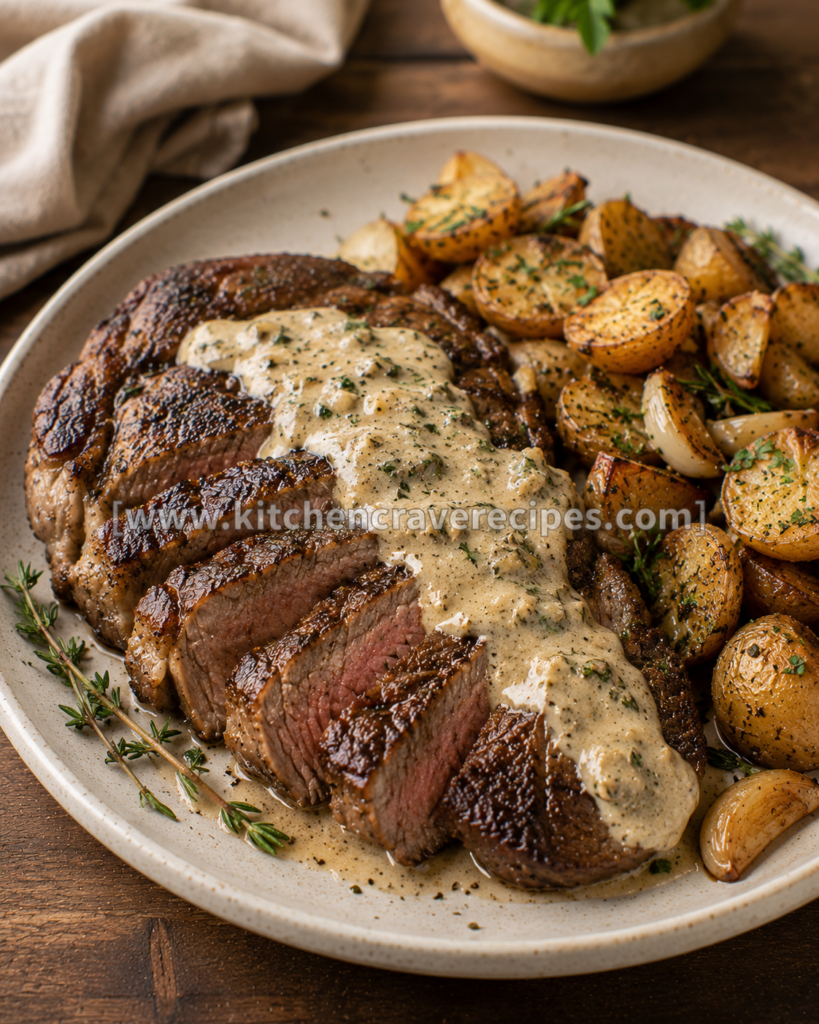
The primary technique here is sautéing, and it does all the heavy lifting. A screaming-hot skillet builds that dark, caramelized crust you see in the photo — the kind that locks in every drop of beefy juice — while the cream sauce comes together in the same pan in under five minutes. Everything finishes together so the potatoes soak up the pan drippings while the sauce settles over the steak like a warm, herby blanket.
Recipe Quick Info
| Detail | Info |
|---|---|
| Prep Time | 15 minutes |
| Cook Time | 30 minutes |
| Total Time | 45 minutes |
| Servings | 2–3 servings |
| Cuisine | American |
| Course | Main Course / Dinner |
| Cooking Method | Sautéing |
| Calories | ~680 kcal per serving |
| Difficulty | Standard |
Why You’ll Love This Creamy Garlic Herb Steak
- One-pan cleanup — The steak, sauce, and roasted potatoes all cook in or finish in the same pan, keeping dishes to a minimum on a busy night.
- Sauce that’s genuinely restaurant-quality — Heavy cream, minced garlic, and a generous handful of fresh chives create a sauce that tastes like it took hours but comes together in about 4 minutes flat.
- The sauté method gives you unmatched crust — High heat in a heavy skillet produces that deep mahogany sear you see in the photo that no oven bake can fully replicate.
- Flexible cut choices — Ribeye, New York strip, or sirloin all work beautifully here; the sauce is rich enough to complement any of them without overpowering the beef.
- Potatoes built right into the dish — Golden, fork-tender potato wedges roast alongside everything and absorb the herby pan drippings, making them arguably the best part of the plate.
- Impressive enough for guests, fast enough for Tuesday — The whole thing is on the table in 45 minutes, but it looks and tastes like a special occasion dinner.
- Totally customizable heat level — A pinch of red pepper flakes in the cream sauce adds a gentle warmth; leave them out entirely for a kid-friendly, crowd-pleasing version.
Ingredients
For the Roasted Potatoes
- 1 lb Yukon Gold potatoes, cut into 1½-inch wedges
- 2 tablespoons olive oil
- ½ teaspoon garlic powder
- ½ teaspoon kosher salt
- ¼ teaspoon black pepper
- ½ teaspoon dried rosemary
For the Steak
- 2 boneless ribeye steaks (about 10–12 oz each, 1 to 1¼ inches thick)
- 1 teaspoon kosher salt
- ½ teaspoon black pepper
- ½ teaspoon smoked paprika
- 1 tablespoon neutral oil (avocado or canola oil)
- 2 tablespoons unsalted butter
For the Creamy Garlic Herb Sauce
- 4 cloves garlic, finely minced
- ¾ cup heavy cream
- ¼ cup low-sodium chicken or beef broth
- 1 teaspoon Dijon mustard
- ½ teaspoon dried thyme
- 3 tablespoons fresh chives, finely chopped (plus extra for garnish)
- 2 tablespoons fresh parsley, finely chopped
- Salt and black pepper to taste
- Pinch of red pepper flakes (optional)
Optional Add-Ins
- 1 tablespoon grated Parmesan (stirs into the sauce for a nuttier finish)
- 1 teaspoon fresh lemon juice (brightens the cream sauce)
- 1 sprig fresh thyme added to the pan while searing
Substitution Guide
| Original Ingredient | Easy Substitute | Notes |
|---|---|---|
| Ribeye steak | New York strip or sirloin | Sirloin is leaner; add 1 min less cook time per side |
| Heavy cream | Half-and-half | Sauce will be thinner; reduce slightly longer |
| Fresh chives | Green onion tops | Use both white and green parts, finely sliced |
| Yukon Gold potatoes | Baby red potatoes or fingerlings | No need to cut if using fingerlings |
| Dijon mustard | Whole grain mustard | Adds texture; slightly sharper flavor |
| Chicken broth | Vegetable broth or white wine | White wine adds depth; use ¼ cup dry |
Kitchen Tools Needed
- Large, heavy-bottomed skillet or cast-iron pan — Essential for the sauté method. A 12-inch cast-iron or stainless steel skillet reaches the high heat needed to build a proper crust; nonstick pans won’t get hot enough for a real sear.
- Rimmed baking sheet or roasting pan — For the potatoes, which roast in the oven while you sauté the steak.
- Tongs — For flipping the steak cleanly without piercing the crust.
- Instant-read meat thermometer — For hitting the exact doneness you want without cutting into the steak and losing the juices.
- Cutting board + sharp chef’s knife — For slicing potatoes and mincing the garlic and herbs.
- Measuring cups and spoons
- Small whisk or wooden spoon — For building the cream sauce in the same skillet without lumps.
Step-by-Step Instructions
Step 1 — Preheat the Oven and Prep the Potatoes (5 minutes)
Preheat your oven to 425°F. Toss the potato wedges with olive oil, garlic powder, kosher salt, black pepper, and dried rosemary directly on a rimmed baking sheet. Spread them in a single layer — crowding causes steaming instead of roasting, and you want those edges to go golden and slightly crisp. Slide the pan into the preheated oven and roast for 25–28 minutes, flipping once at the halfway mark.
Step 2 — Season the Steaks (3 minutes)
Pat both ribeyes completely dry with paper towels — this step is non-negotiable for a good sear. Moisture on the surface of the steak creates steam in the pan, which prevents browning and gives you a gray, sad exterior instead of that deep mahogany crust. Season generously on all sides with kosher salt, black pepper, and smoked paprika. Let them rest at room temperature while the potatoes begin their head start in the oven (at least 5–10 minutes of rest helps them cook more evenly).
Step 3 — Sauté the Steaks (8–10 minutes total)
Heat your cast-iron or stainless steel skillet over high heat for 2 full minutes — the pan should be smoking slightly before anything goes in. Add the neutral oil and swirl to coat. Carefully lay the steaks away from you into the pan. You should hear an aggressive, loud sizzle the moment they hit the surface; if you don’t, the pan isn’t hot enough. Sauté undisturbed for 3–4 minutes on the first side until a deep brown crust forms and the steak releases naturally from the pan. Flip once with tongs, add the butter to the pan, and sauté the second side for 3–4 minutes while tilting the pan and spooning the foamy butter over the steak repeatedly. This basting technique — called “arrosage” — is what builds that glistening, lacquered surface you see in the photo.
Embedded tip: For medium-rare, pull the steak at an internal temperature of 130°F measured at the thickest point with your instant-read thermometer — the USDA recommends a minimum of 145°F for whole muscle beef with a 3-minute rest (USDA safe minimum internal temperatures). For medium, aim for 140°F before resting.
Step 4 — Rest the Steaks (5 minutes)
Transfer the sautéed steaks to a cutting board and tent loosely with foil. Let them rest for 5 minutes — this allows the muscle fibers to relax and the juices to redistribute through the meat rather than running out onto the cutting board the moment you slice. Do not skip this step. While they rest, build the sauce in the same hot skillet without washing it — those browned bits on the pan bottom (called fond) are pure flavor.
Step 5 — Build the Creamy Garlic Herb Sauce (4–5 minutes)
Reduce the burner to medium heat. Add the minced garlic to the skillet and sauté for 45–60 seconds, stirring constantly, until it’s fragrant and just turning golden at the edges. Pour in the broth and use a wooden spoon to scrape up every bit of the fond from the bottom of the pan — that’s where the depth of flavor lives. Add the heavy cream and Dijon mustard, whisking to combine. Let the sauce simmer gently (small, lazy bubbles around the edges — not a rolling boil) for 2–3 minutes until it thickens enough to coat the back of a spoon. Stir in the dried thyme, fresh chives, and fresh parsley. Season with salt, pepper, and red pepper flakes if using.
Embedded tip: If the sauce tightens up too much, add a splash of broth — 1–2 tablespoons at a time — and whisk it back to a pourable consistency before plating.
Step 6 — Plate and Finish (2 minutes)
Pull the potatoes from the oven — they should be golden and fork-tender with crispy edges. Arrange the potato wedges in the base of the roasting pan or a large serving dish, nestle the rested steaks on top, and pour the creamy garlic herb sauce generously over the steaks. Finish with a scatter of extra fresh chives and parsley. Serve immediately.
Pro Tips for the Best Creamy Garlic Herb Steak
- Get your pan to the right temperature before the steak goes in. For sautéing steak, heat is everything. Set your burner to high, wait a full 2 minutes, then add oil — if a drop of water flicked into the pan vaporizes instantly, you’re ready. A pan that isn’t hot enough will boil the steak in its own juices instead of searing it.
- Use a neutral oil with a high smoke point for the sear, then switch to butter for basting. Butter burns at high sauté temperatures but adds irreplaceable flavor; starting with avocado or canola oil prevents scorching while still letting you add butter for richness once you flip.
- Mince the garlic by hand, not with a press. A press can turn garlic almost to paste, which burns quickly in a hot pan. Fine hand-minced pieces have more surface area control and toast more evenly in the residual heat of the skillet.
- Always rest the steak before slicing. Five minutes of resting after sautéing isn’t optional — it’s what separates a juicy steak from a dry one. Set a timer and use that time to make the sauce.
- Taste and season the cream sauce at the very end. Heavy cream mutes salt, so always do a final taste right before serving and adjust accordingly — the sauce should taste boldly seasoned on its own because it dilutes slightly once it’s over the meat.
Common Mistakes to Avoid
1. Not drying the steak before sautéing.
Surface moisture turns to steam in the pan, killing the Maillard reaction that creates the crust. Pat steaks bone-dry with paper towels every single time.
2. Crowding the sauté pan.
If you’re cooking for more than two, resist the urge to add a third steak to the pan. Overcrowding drops the pan temperature dramatically, and the steaks will steam rather than sear — cook in batches if needed.
3. Flipping the steak too early.
A properly sautéed steak will release naturally from the pan when the crust is ready. If it’s sticking, it hasn’t formed its crust yet. Wait another 30–60 seconds before trying again.
4. Letting the garlic burn in the sauce.
Once the steaks come out, the pan is still very hot. Add garlic to medium — not high — heat and watch it constantly for 45–60 seconds. Burnt garlic turns the sauce bitter and there’s no fixing it; you’d have to start over.
5. Boiling the cream sauce instead of simmering it.
A rolling boil causes cream to break — the fat separates and you end up with a greasy, grainy sauce instead of a silky one. Keep the heat at medium and look for lazy, small bubbles around the pan’s edge.
6. Skipping the meat thermometer.
Guessing doneness by touch is a skill that takes years to develop reliably. An instant-read thermometer guarantees you hit your target every time, whether you want medium-rare at 130°F or medium at 140°F.
7. Under-seasoning the sauce.
Heavy cream is rich and naturally mute. The sauce needs more salt than you’d expect — taste it before plating and season assertively.
8. Cutting the steak immediately after cooking.
This is the mistake that turns a great piece of meat into a puddle of juice on the cutting board. Always rest for a minimum of 5 minutes after sautéing.
Variations
Healthy Version
Swap the heavy cream for full-fat coconut cream (it sauces similarly without adding dairy calories) and use a leaner sirloin steak instead of ribeye. For the potatoes, cut the olive oil to 1 tablespoon and increase the rosemary for more flavor without the fat. The sauté technique remains the same — just be aware the coconut cream sauce will have a very faint sweetness that pairs nicely with the herbs.
Vegetarian Version
Replace the steak with two large portobello mushroom caps (stems removed), each about ¾-inch thick. Sauté them in butter over high heat for 3–4 minutes per side until deeply browned and tender. The sauce recipe is identical — mushrooms are naturally umami-rich and pair beautifully with the creamy garlic herb combination. Use vegetable broth instead of chicken or beef broth in the sauce.
Spicy Version
Add ½ teaspoon of crushed red pepper flakes and a pinch of cayenne directly to the cream sauce along with the herbs. You can also rub the steak with a mix of smoked paprika and chipotle powder before sautéing for an extra smoky heat on the crust. The cream sauce tempers the spice just enough to keep it warm rather than overwhelming.
Gluten-Free Version
This recipe is naturally gluten-free as written — just verify that your Dijon mustard and chicken or beef broth labels confirm no gluten-containing additives. Serve over steamed rice or alongside a simple green salad in place of potatoes if you prefer a lighter base.
Low-Carb / Keto Version
Skip the potatoes entirely and serve the sautéed steak and cream sauce over roasted cauliflower florets or steamed broccoli — both hold up beautifully to the rich sauce. The steak and sauce themselves are already keto-compliant. If you want to keep some root vegetables, roasted radishes at 425°F caramelize similarly to potatoes with a fraction of the carbs.
What to Serve With This Recipe
- A simple green salad with lemon vinaigrette — the acidity cuts through the richness of the cream sauce beautifully.
- Steamed broccolini or asparagus — lightly seasoned; a vegetal, slightly bitter side balances the savory steak.
- Crusty sourdough bread — essential for mopping up every last drop of that garlic herb cream sauce from the pan.
- A dry red wine — Cabernet Sauvignon or Malbec pairs classically with a sautéed ribeye; the tannins stand up to the rich cream sauce.
- Creamed spinach — a steakhouse-style side that doubles down on the comfort; try Garlic Butter Salmon Creamy Sauce in 35 Min for a 10-minute version.
- Roasted garlic dinner rolls — for a fully indulgent, shareable spread when you’re cooking for a crowd.
- Simple cucumber and tomato salad — cool, crisp, and refreshing as a palate-cleanser between bites of rich steak.
Storage Instructions
Refrigerator
Store leftover steak and potatoes in separate airtight containers — the potatoes will hold their texture better when not submerged in sauce. Store the cream sauce in its own small container. Everything keeps well in the refrigerator for up to 3 days. Reheat the sauce gently and re-pour it over the steak just before serving to avoid overcooking the meat during reheating.
Freezer
The cream sauce does not freeze well — dairy-based cream sauces tend to separate when thawed, resulting in a grainy texture. You can freeze the cooked steak on its own (tightly wrapped in plastic wrap and then foil) for up to 2 months. Thaw overnight in the refrigerator. Make a fresh batch of cream sauce when you’re ready to serve — it only takes 5 minutes.
The roasted potatoes can be frozen in a single layer on a sheet pan before transferring to a freezer bag. Reheat directly from frozen in a 400°F oven for 10–12 minutes.
Shelf Life Summary
| Component | Refrigerator | Freezer |
|---|---|---|
| Cooked steak | Up to 3 days | Up to 2 months (without sauce) |
| Cream herb sauce | Up to 3 days | Not recommended |
| Roasted potatoes | Up to 4 days | Up to 1 month |
Reheating Instructions
Oven (Best for the Steak)
Preheat to 275°F. Place the steak on a wire rack set over a baking sheet and warm for 10–15 minutes until the internal temperature reads 110–120°F. Finish with 1–2 minutes in a preheated skillet with a little butter to revive the crust. This low-and-slow method avoids cooking the steak further past its original doneness.
Microwave (Fastest Option)
Place steak slices in a microwave-safe dish, cover loosely with a damp paper towel, and heat in 30-second intervals on 60% power until just warmed through — typically 60–90 seconds total. Reheat the cream sauce separately in a small saucepan or microwave-safe bowl, stirring frequently to keep it from breaking. According to FDA food safety guidance, leftovers should reach 165°F internally before consuming.
Stovetop (Best for the Sauce and Potatoes)
Reheat the cream sauce in a small saucepan over low heat, stirring constantly with a whisk. If it’s too thick, add 1–2 tablespoons of broth and whisk back to a silky consistency. Reheat potatoes in a dry skillet over medium heat for 4–5 minutes, tossing occasionally, until the edges crisp back up.
Nutrition Facts
Per serving (approximately ⅓ of recipe, including sauce and potatoes)
| Nutrient | Amount |
|---|---|
| Calories | ~680 kcal |
| Total Fat | 48g |
| Saturated Fat | 21g |
| Cholesterol | 165mg |
| Sodium | 620mg |
| Total Carbohydrates | 22g |
| Dietary Fiber | 2.5g |
| Sugars | 2g |
| Protein | 42g |
Disclaimer: Nutrition values are estimates calculated using standard ingredient databases and will vary based on the specific cut and size of steak used, the exact fat content of your cream, and any substitutions made. These figures are provided for general informational purposes and are not intended as medical or dietary advice. Always consult a registered dietitian for personalized nutrition guidance.
Frequently Asked Questions
1. Can I use a different cut of steak for this creamy garlic herb steak recipe?
Absolutely. Ribeye is shown in the photo and gives the richest result, but New York strip is an excellent substitute with slightly less fat marbling. Sirloin works well too and is more budget-friendly — just reduce the sauté time by about 1 minute per side since it’s leaner and cooks faster.
2. What’s the best pan for sautéing steak at home?
A 12-inch cast-iron skillet is the gold standard — it holds heat exceptionally well and produces the best crust. A heavy stainless steel skillet is a close second. Avoid nonstick pans for searing steak; they can’t safely reach the high temperatures needed without damaging the coating.
3. How do I know when the cream sauce is the right consistency?
Dip a spoon into the sauce and run your finger across the back of it — if the line holds clean and the sauce doesn’t run back into it, the consistency is perfect. If it runs immediately, give it another 60 seconds over medium heat.
4. Can I make the herb cream sauce ahead of time?
Yes, but only partially. You can mince the garlic and chop the herbs up to 24 hours ahead and store them covered in the refrigerator. The sauce itself is best made fresh in the pan right after cooking the steak — it only takes 4–5 minutes and uses the flavorful fond from the pan that you can’t recreate in advance.
5. My cream sauce broke and looks greasy — how do I fix it?
This usually happens if the heat was too high. Remove the pan from heat immediately, add 1 tablespoon of cold heavy cream, and whisk vigorously — this often brings it back together. Going forward, keep the burner at medium rather than medium-high when building cream-based sauces.
6. Can I bake this instead of sautéing it on the stovetop?
You can bake the steak if needed, but you’ll sacrifice the crust. For an oven method, preheat to 450°F, sear the steak in an oven-safe skillet on the stovetop for 2 minutes per side, then transfer to the oven for 4–6 minutes to finish. The sauce still needs to be built on the stovetop — it won’t come together properly in the oven.
7. How thick should the steaks be for this recipe?
Aim for 1 to 1¼ inches thick. Thinner steaks cook through too quickly during sautéing, giving you less time to build the crust before the interior overcooks. Thicker than 1¼ inches may require finishing in a 375°F oven for 4–5 minutes after the stovetop sear to reach the correct internal temperature.
8. Can I double the recipe for a larger group?
Yes — double all ingredient quantities. For the steak, cook in two separate batches rather than crowding the pan (see Common Mistakes #2 above). Make the sauce once after both batches are done, using all the accumulated fond. Potatoes can be doubled on two sheet pans at the same time in the oven without issue.
9. Do I have to use fresh herbs, or will dried work?
Fresh chives and parsley make a significant visual difference here (you can see the vibrant green in the photo) and their flavor is brighter in the cream sauce. In a pinch, use 1 teaspoon of dried chives and 1 teaspoon of dried parsley — the flavor will be more muted and the color less vivid, but it still works.
10. How do I get the potatoes crispy and the steak done at the same time?
The timing is designed for this: the potatoes get a 15–18 minute head start in the oven. By the time you’ve sautéed the steak (8–10 minutes), rested it (5 minutes), and made the sauce (4–5 minutes), the potatoes will be finishing their 28-minute roast at almost exactly the right moment. Stick to the timing in the steps and everything lands together.
11. What wine works best with this dish?
A full-bodied red wine is the classic match — Cabernet Sauvignon, Malbec, or a bold Côtes du Rhône all work well alongside a sautéed ribeye. If you prefer white wine, an oaked Chardonnay can hold its own against the cream sauce without being overwhelmed.
12. Is this recipe freezer-meal friendly?
The steak itself freezes fine (up to 2 months, tightly wrapped). The cream sauce, however, does not freeze well and should be made fresh. See the Storage section above for details on freezing each component separately.
Expert Chef Tips
1. Always bring steak to near room temperature before sautéing.
Cold steak straight from the refrigerator cooks unevenly — the exterior overcooks before the center reaches temperature. Pull your steaks out 15–20 minutes before you plan to cook for a more even result from edge to center.
2. Use the fond — never wash the pan between the steak and the sauce.
The dark, sticky bits stuck to the bottom of the skillet after sautéing the steak are called fond, and they’re concentrated, caramelized beef flavor. Deglazing with broth and scraping them up is what gives the cream sauce its depth; skipping this step makes the sauce taste flat.
3. Season in layers, not just at the end.
Salt the steak before it hits the pan, season the sauce as you build it, and then taste and adjust again right before serving. Layered seasoning creates complexity; a single seasoning step at the end just makes food taste salty without depth.
4. If your steak is browning unevenly, press it gently with tongs.
Hot spots in the pan can cause uneven browning, especially with slightly thicker cuts. Applying gentle, even pressure across the surface for about 10 seconds keeps the steak in full contact with the pan and helps the crust develop uniformly.
5. Finish the sauce with a tiny knob of cold butter right before plating.
Just ½ teaspoon of cold butter whisked into the sauce at the very end — a classic French technique called “monter au beurre” — adds a glossy sheen and a silky mouthfeel that makes the sauce look and taste genuinely restaurant-polished. For more technique-driven dinner ideas, check out Garlic Butter Salmon Creamy Sauce in 35 Min.
Recipe Summary
This creamy garlic herb steak starts with ribeyes sautéed in a screaming-hot cast-iron skillet to build a deep, caramelized crust, then finishes with a velvety cream sauce built directly in the same pan using the beef’s own fond. Golden roasted potato wedges round out the plate, making this a complete, satisfying dinner. The whole meal comes together in 45 minutes with minimal equipment and maximum flavor — genuinely the kind of dish that earns a permanent spot in your regular dinner rotation.
Conclusion
If you’ve been searching for a steak dinner that feels special without requiring a culinary degree or two hours in the kitchen, this creamy garlic herb steak is exactly what you’ve been looking for. The sauté method does the work — building real crust, real flavor, and a sauce that tastes like it came from a steakhouse kitchen rather than a weeknight stovetop. Once you make it once, the technique becomes second nature. Slice into it, let that cream sauce pool around the golden potatoes, and enjoy every single bite. If you make it, come back and leave a comment — I’d love to hear how it turned out at your table. For another indulgent but achievable weeknight dinner, don’t miss Garlic Butter Salmon Creamy Sauce in 35 Min.
Best Creamy Garlic Herb Steak — 5-Star Easy Dinner
Description
There are weeknight dinners, and then there are dinners that make everyone at the table go completely quiet for the first two bites. This creamy garlic herb steak is absolutely the latter. A thick, beautifully seared steak nestled in a roasting pan alongside golden, crispy-edged potatoes, then blanketed in a luscious cream sauce loaded with minced garlic, fresh chives, and green herbs — this dish is the definition of low-effort, high-reward cooking.
Ingredients
Instructions
-
Step-by-Step Instructions
-
Step 1 — Preheat the Oven and Prep the Potatoes (5 minutes)
-
Preheat your oven to 425°F. Toss the potato wedges with olive oil, garlic powder, kosher salt, black pepper, and dried rosemary directly on a rimmed baking sheet. Spread them in a single layer — crowding causes steaming instead of roasting, and you want those edges to go golden and slightly crisp. Slide the pan into the preheated oven and roast for 25–28 minutes, flipping once at the halfway mark.
-
Step 2 — Season the Steaks (3 minutes)
-
Pat both ribeyes completely dry with paper towels — this step is non-negotiable for a good sear. Moisture on the surface of the steak creates steam in the pan, which prevents browning and gives you a gray, sad exterior instead of that deep mahogany crust. Season generously on all sides with kosher salt, black pepper, and smoked paprika. Let them rest at room temperature while the potatoes begin their head start in the oven (at least 5–10 minutes of rest helps them cook more evenly).
-
Step 3 — Sauté the Steaks (8–10 minutes total)
-
Heat your cast-iron or stainless steel skillet over high heat for 2 full minutes — the pan should be smoking slightly before anything goes in. Add the neutral oil and swirl to coat. Carefully lay the steaks away from you into the pan. You should hear an aggressive, loud sizzle the moment they hit the surface; if you don't, the pan isn't hot enough. Sauté undisturbed for 3–4 minutes on the first side until a deep brown crust forms and the steak releases naturally from the pan. Flip once with tongs, add the butter to the pan, and sauté the second side for 3–4 minutes while tilting the pan and spooning the foamy butter over the steak repeatedly. This basting technique — called "arrosage" — is what builds that glistening, lacquered surface you see in the photo.
-
Embedded tip: For medium-rare, pull the steak at an internal temperature of 130°F measured at the thickest point with your instant-read thermometer — the USDA recommends a minimum of 145°F for whole muscle beef with a 3-minute rest (USDA safe minimum internal temperatures). For medium, aim for 140°F before resting.
-
Step 4 — Rest the Steaks (5 minutes)
-
Transfer the sautéed steaks to a cutting board and tent loosely with foil. Let them rest for 5 minutes — this allows the muscle fibers to relax and the juices to redistribute through the meat rather than running out onto the cutting board the moment you slice. Do not skip this step. While they rest, build the sauce in the same hot skillet without washing it — those browned bits on the pan bottom (called fond) are pure flavor.
-
Step 5 — Build the Creamy Garlic Herb Sauce (4–5 minutes)
-
Reduce the burner to medium heat. Add the minced garlic to the skillet and sauté for 45–60 seconds, stirring constantly, until it's fragrant and just turning golden at the edges. Pour in the broth and use a wooden spoon to scrape up every bit of the fond from the bottom of the pan — that's where the depth of flavor lives. Add the heavy cream and Dijon mustard, whisking to combine. Let the sauce simmer gently (small, lazy bubbles around the edges — not a rolling boil) for 2–3 minutes until it thickens enough to coat the back of a spoon. Stir in the dried thyme, fresh chives, and fresh parsley. Season with salt, pepper, and red pepper flakes if using.
-
Embedded tip: If the sauce tightens up too much, add a splash of broth — 1–2 tablespoons at a time — and whisk it back to a pourable consistency before plating.
-
Step 6 — Plate and Finish (2 minutes)
-
Pull the potatoes from the oven — they should be golden and fork-tender with crispy edges. Arrange the potato wedges in the base of the roasting pan or a large serving dish, nestle the rested steaks on top, and pour the creamy garlic herb sauce generously over the steaks. Finish with a scatter of extra fresh chives and parsley. Serve immediately.
Nutrition Facts
Servings 3
- Amount Per Serving
- Calories 680kcal
- % Daily Value *
- Total Fat 48g74%
- Saturated Fat 21g105%
- Protein 42g84%
* Percent Daily Values are based on a 2,000 calorie diet. Your daily value may be higher or lower depending on your calorie needs.

You may also like...