Creamy Garlic Chicken Meatballs — Best 40-Min Ultimate


Creamy Garlic Chicken Meatballs — Best 40-Min Ultimate
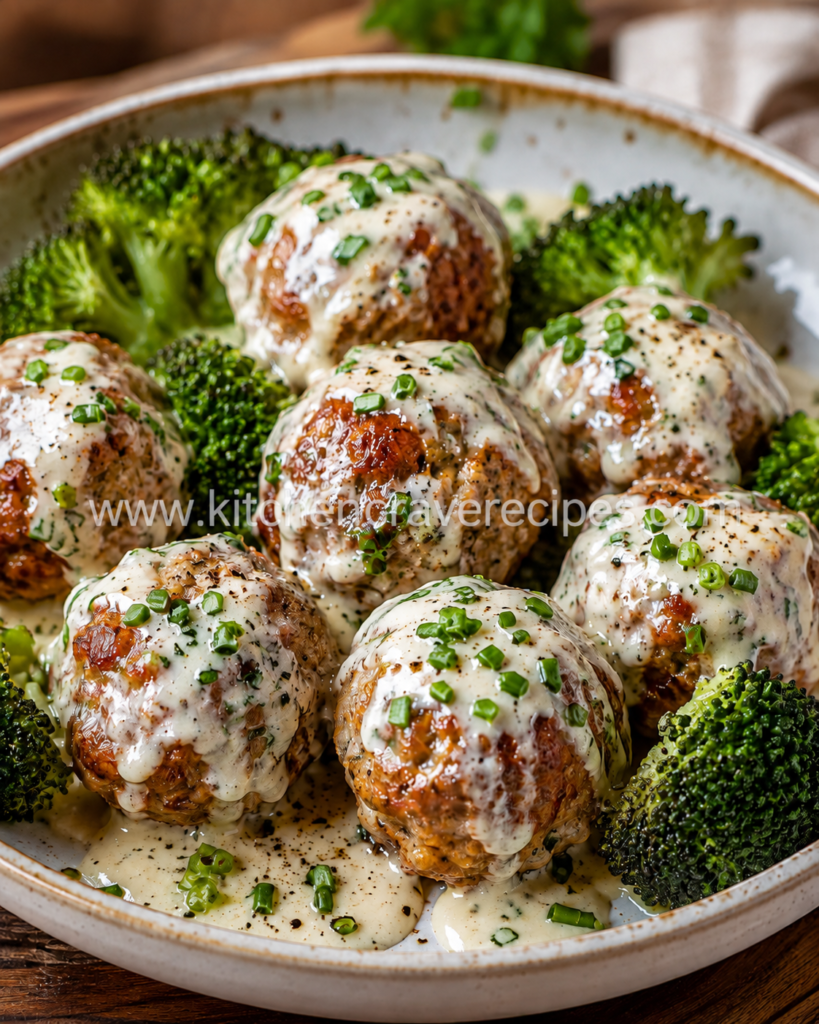
The photo tells you everything you need to know before the first word of this recipe: a wide, shallow bowl piled high with deeply golden-brown chicken meatballs, each one generously draped in a thick, pale garlic cream sauce and finished with a scatter of finely chopped fresh chives. Steamed broccoli crowns nestle in behind the meatballs, soaking up the sauce from below. It’s comfort food with real technique behind it, and it’s built entirely on one pan and one pot.
These creamy garlic chicken meatballs use a two-stage cooking method: sautéing the meatballs in a skillet over medium-high heat to build that deeply browned, crackling exterior, then simmering them gently in the cream sauce to finish cooking through and absorb every bit of the garlicky, herb-forward flavor. The sauté stage develops the crust and the flavor fond in the pan. The simmer stage is where the sauce comes alive — thickening slowly around each meatball until it coats the back of a spoon. Together, those two techniques in sequence produce a result that’s dramatically better than either method alone.
Recipe Quick Info
| Detail | Info |
|---|---|
| Prep Time | 15 minutes |
| Cook Time | 25 minutes |
| Total Time | 40 minutes |
| Servings | 4 |
| Course | Main Course |
| Cuisine | American |
| Cooking Method | Sautéing + Simmering |
| Calories | ~450 per serving |
| Difficulty | Standard |
Why You’ll Love These Creamy Garlic Chicken Meatballs
- One skillet, minimal cleanup — the meatballs sauté and the sauce simmers in the same pan, so the entire recipe builds on a single layer of flavor without multiplying your dish count.
- Golden-brown crust, every time — sautéing in a properly preheated pan gives each meatball a crackling, caramelized exterior that holds up beautifully when the cream sauce goes in.
- Rich, restaurant-quality garlic cream sauce — built from the fond left in the pan after sautéing, the sauce develops genuine depth in under 10 minutes of gentle simmering, not a long slow cook.
- Lighter than traditional beef meatballs — ground chicken is leaner and milder in flavor, which means the garlic cream sauce carries more prominently in every bite without competition from the meat.
- Naturally adaptable to gluten-free — a single swap of the breadcrumb binder makes this accessible without changing the technique or the finished texture of the meatballs.
- Serves as a complete meal with the broccoli built in — steamed broccoli added to the bowl with the meatballs and sauce, as shown in the photo, makes this a nutritionally balanced dinner with no additional sides required.
- Leftovers taste even better the next day — the meatballs continue absorbing the cream sauce overnight in the refrigerator, making reheated portions arguably more flavorful than the first serving.
Ingredients
For the Chicken Meatballs
- 1½ lbs ground chicken (93% lean preferred; 99% fat-free tends to produce dry meatballs)
- ⅓ cup panko breadcrumbs
- 1 large egg, beaten
- 3 cloves garlic, finely minced (divided — 2 for meatballs, 1 for sauce)
- 2 tablespoons fresh flat-leaf parsley, finely chopped
- ¼ cup finely grated Parmesan cheese
- 1 teaspoon kosher salt
- ½ teaspoon black pepper
- ½ teaspoon onion powder
- ½ teaspoon dried Italian seasoning
- 1½ tablespoons olive oil (for sautéing)
For the Creamy Garlic Sauce
- 1 tablespoon unsalted butter
- 1 clove garlic, finely minced
- 1 cup low-sodium chicken broth
- 1 cup heavy cream
- ½ cup freshly grated Parmesan cheese
- 1 teaspoon fresh lemon juice
- ½ teaspoon dried thyme
- ¼ teaspoon black pepper
- ¼ teaspoon kosher salt (adjust to taste after adding Parmesan)
- 1 tablespoon cornstarch mixed with 2 tablespoons cold water (optional, for thicker sauce)
For Serving (as shown in photo)
- 2–3 cups steamed broccoli florets
- 3 tablespoons fresh chives, finely chopped (for garnish — clearly visible in photo)
- Extra grated Parmesan, for finishing
Optional Add-Ins
- ¼ teaspoon crushed red pepper flakes in the meatball mix (adds background heat)
- 1 tablespoon cream cheese blended into the meatball mixture (adds moisture and richness)
- 1 teaspoon Dijon mustard stirred into the sauce (adds depth without changing the flavor profile significantly)
Substitution Guide
| Original Ingredient | Substitution | Notes |
|---|---|---|
| Ground chicken | Ground turkey | Nearly identical fat content and texture behavior |
| Panko breadcrumbs | Almond flour (gluten-free) | Use ¼ cup; produces a slightly denser meatball |
| Heavy cream | Half-and-half | Thinner sauce; use the cornstarch slurry to compensate |
| Fresh parsley | Fresh basil or fresh chives | Chives echo the garnish visible in the photo |
| Parmesan (meatballs) | Pecorino Romano | Saltier and sharper; reduce added salt slightly |
| Chicken broth | Vegetable broth | Lighter flavor but works well in this sauce |
Kitchen Tools Needed
- Large skillet (12-inch, stainless steel or cast iron) — essential for sautéing the meatballs over medium-high heat and building the fond that becomes the sauce base
- Wooden spoon or silicone spatula — for scraping up the fond when building the cream sauce
- Large mixing bowl — for combining the meatball ingredients without overworking
- Cookie scoop or tablespoon measure — for portioning meatballs to a consistent size (1½ inches), which ensures even sautéing and simmering times
- Instant-read thermometer — to confirm the meatballs have reached the USDA-recommended safe internal temperature of 165°F for all ground poultry
- Tongs or a spoon — for turning meatballs in the skillet during sautéing
- Microplane or box grater — for freshly grating Parmesan into both the meatball mixture and the sauce; pre-grated Parmesan melts less smoothly
- Small bowl — for mixing the optional cornstarch slurry
- Ladle or large spoon — for spooning the finished cream sauce over the plated meatballs
Step-by-Step Instructions
Step 1: Mix the Meatball Mixture
Combine the ground chicken, panko, beaten egg, 2 cloves of minced garlic, parsley, Parmesan, salt, pepper, onion powder, and Italian seasoning in a large mixing bowl. Mix with your hands or a fork until the ingredients are just combined — stop the moment no dry streaks of panko remain. Overmixing develops the proteins in ground chicken and produces a dense, rubbery meatball rather than a tender one. The mixture will feel softer and stickier than a beef meatball mixture; this is normal for ground chicken and produces a better final texture.
Embedded Tip: Wet your hands with cold water before rolling each meatball. The water creates a barrier between your warm palms and the sticky ground chicken, making rolling significantly cleaner and producing more uniformly round shapes.
Step 2: Portion and Roll the Meatballs
Using a 1½-tablespoon cookie scoop or two spoons, portion the mixture into balls of equal size and roll briefly between your palms to smooth. Aim for 20–22 meatballs, each approximately 1½ inches in diameter. Consistent size is critical for the sauté stage — meatballs that vary in size will have some that are overcooked when the smallest ones are done, and some that are undercooked when the largest ones are ready. Place the rolled meatballs on a parchment-lined plate while you heat the skillet.
Step 3: Sauté the Meatballs Until Golden
Heat the olive oil in a 12-inch skillet over medium-high heat until the oil shimmers visibly and a drop of water flicked in sizzles and evaporates immediately. Add the meatballs in a single layer — work in two batches if needed, never crowding the pan (see Common Mistakes). Let them sear undisturbed for 3–4 minutes until the bottom is a deep golden-brown and releases cleanly from the pan. Turn each meatball using tongs, browning the second side for 2–3 more minutes. The meatballs won’t be fully cooked through yet at this stage — they’ll finish in the sauce during simmering.
Step 4: Remove the Meatballs and Build the Sauce Base
Transfer the sautéed meatballs to a clean plate and reduce the heat to medium. Leave the rendered fat and all the golden-brown fond (the caramelized bits stuck to the pan) in the skillet — this is the flavor foundation of the cream sauce. Add the butter and let it melt, then add the remaining clove of minced garlic. Stir for 60 seconds, scraping up the fond as the garlic sizzles and turns fragrant and just barely golden at the edges — it should smell sweet and toasted, not sharp or raw.
Step 5: Add the Liquids and Begin Simmering
Pour the chicken broth into the skillet and use the wooden spoon to deglaze completely — scrape every bit of the fond from the bottom of the pan into the liquid. Bring to a gentle simmer over medium heat, then pour in the heavy cream, dried thyme, black pepper, and salt. Stir to combine. The sauce will look thin at this point; don’t be alarmed. Reduce the heat to medium-low — you want small, lazy bubbles breaking the surface every 2–3 seconds, not a vigorous boil that can cause the cream to separate.
Embedded Tip: Watch for the visual difference between a simmer and a boil. A proper simmer for this cream sauce looks like gentle, occasional bubbles at the surface — almost like the sauce is breathing. The moment you see a rolling boil with large, rapid bubbles, reduce the heat immediately or the cream can break into a greasy, separated sauce.
Step 6: Return the Meatballs and Simmer to Finish
Return the sautéed meatballs to the skillet, nestling them into the simmering cream sauce. Spoon the sauce over any meatballs that aren’t fully submerged. Cover the skillet partially with a lid (leave a 1-inch gap to allow steam to escape) and simmer on medium-low for 10–12 minutes, until the meatballs are cooked through and the sauce has thickened noticeably. The sauce is ready when it coats the back of a spoon and a line drawn through it with your finger holds for 2–3 seconds. Stir in the freshly grated Parmesan and lemon juice, taste for seasoning, and adjust salt and pepper as needed.
Step 7: Check Doneness and Plate
Use an instant-read thermometer to confirm the internal temperature of the largest meatball has reached 165°F at its center. Transfer the meatballs and sauce to a wide, shallow serving bowl (as shown in the photo), arrange the steamed broccoli florets around and behind the meatballs, and spoon extra sauce over everything. Finish with a generous scatter of fresh chives and extra Parmesan. Serve immediately while the sauce is fluid and the meatballs are at their most tender.
Pro Tips for Perfect Creamy Garlic Chicken Meatballs
Simmering tip — keep the heat lower than feels right. Heavy cream-based sauces are more stable at a lazy simmer than they are at a vigorous one. If the sauce starts visibly bubbling rapidly, reduce the heat immediately rather than waiting to see if it corrects itself. Rapid boiling causes the fat to separate from the liquid, producing a broken, greasy sauce that won’t coat the meatballs smoothly.
Sauté in batches without exception. Crowding the pan drops the temperature so sharply that the meatballs steam rather than sear, producing a gray, soft exterior instead of the golden-brown crust visible in the photo. A proper sear also builds more fond in the pan, which translates directly to a more complex, deeper-flavored cream sauce. Two batches of 10–11 meatballs is far better than one crowded batch.
Grate the Parmesan yourself, always. Pre-shredded Parmesan is coated in cellulose or potato starch to prevent clumping, and those anti-caking agents prevent the cheese from melting smoothly into a cream sauce — you’ll see white flecks instead of a cohesive, glossy sauce. A microplane or the fine side of a box grater produces Parmesan that dissolves into the cream within 30 seconds of stirring.
Chill the meatball mixture if it’s too soft to roll. Ground chicken is naturally wetter than beef, and if your kitchen is warm, the mixture can become very sticky and hard to shape. Refrigerate the mixed but unrolled meatball mixture for 15–20 minutes — the cold firms the fat and makes rolling dramatically easier and cleaner.
Common Mistakes to Avoid
1. Crowding the pan during sautéing (sautéing-specific mistake).
This is the single most common meatball mistake. When too many meatballs share the pan, the temperature drops and they steam in their own moisture rather than searing. Cook in batches of 10–11 maximum in a 12-inch skillet, with visible space between each meatball, and don’t move them until the crust releases naturally.
2. Overworking the meatball mixture.
Ground chicken is leaner and more delicate than beef, and vigorous mixing develops the proteins into a tight, rubbery network. Mix only until the ingredients are just combined. If you see no dry streaks of panko, stop immediately — even 30 extra seconds of mixing noticeably affects the finished texture.
3. Letting the cream sauce boil hard.
A rolling boil forces the fat out of emulsion in a cream-based sauce. Once the cream goes in, the heat must stay at medium-low and the surface should show only a gentle simmer. If the sauce breaks, whisk in 1–2 tablespoons of cold chicken broth off the heat to help re-emulsify.
4. Skipping the fond deglaze.
The golden-brown bits left in the pan after sautéing are concentrated chicken fat, caramelized proteins, and Maillard reaction compounds — all flavor. Pouring in the broth and scraping them up is what makes the cream sauce taste like it simmered for an hour rather than 10 minutes. Don’t rinse or wipe the pan between the sauté and sauce steps.
5. Adding Parmesan to a boiling sauce.
Parmesan added to a sauce that’s at a full boil will clump and become stringy rather than melting smoothly. Always reduce the heat to low before stirring in the Parmesan, and add it in small handfuls while stirring continuously. This is the step that separates a smooth, cohesive sauce from a grainy one.
6. Not checking the internal temperature.
Visual cues for ground chicken meatballs are unreliable — the outside can look fully cooked while the center is still underdone. Always use an instant-read thermometer and confirm 165°F in the largest meatball before serving. This is especially important since the meatballs are partially cooked during sautéing and finish during simmering.
7. Salting before tasting at the end.
Both Parmesan and chicken broth contribute significant sodium to the sauce. Always taste and adjust salt after the Parmesan and broth are fully incorporated — what seems under-seasoned before the cheese goes in often needs no additional salt at all after.
Variations
Healthy / Lower-Calorie Version
Replace the heavy cream with 1 cup of evaporated skim milk combined with 1 tablespoon of cornstarch — whisk together before adding to the pan. The result is a lighter sauce that still coats the meatballs well at approximately 300 calories per serving. Reduce the Parmesan in the sauce to ¼ cup and add an extra ½ teaspoon of lemon juice for brightness to compensate for the reduced richness. Use the same sauté and simmer method with no timing adjustments.
Vegetarian Version
Replace the ground chicken with a mixture of cooked, finely crumbled white beans (1 cup) and finely diced and sautéed mushrooms (1 cup, moisture fully evaporated). Bind with the same egg, panko, Parmesan, and seasoning ratio. The texture is softer than a chicken meatball, so handle gently during sautéing — use a thin spatula rather than tongs. The cream sauce recipe and simmering method remain identical.
Spicy Version
Add ½ teaspoon of crushed red pepper flakes and ¼ teaspoon of cayenne to the meatball mixture, and stir 1 teaspoon of Calabrian chili paste into the cream sauce after the broth deglazes. The heat is noticeable but balanced by the richness of the cream and Parmesan. Serve with extra chives and a squeeze of lemon to keep the heat in check.
Gluten-Free Version
Swap the panko for an equal volume of almond flour (⅓ cup). Almond flour produces a slightly denser meatball that holds together well during sautéing. Verify that your chicken broth brand is labeled gluten-free; most are, but cross-contamination varies by brand. All other ingredients in the recipe are naturally gluten-free — no other substitutions are needed.
Low-Carb / Keto Version
Replace the panko with ¼ cup of almond flour and add 1 tablespoon of cream cheese to the meatball mixture to compensate for the reduced binding from the almond flour. Omit the cornstarch slurry from the sauce (it’s optional anyway) and let the sauce reduce naturally — extended low-heat simmering by an additional 5 minutes thickens the sauce without any starch. Each serving drops to approximately 8 grams of net carbs, well within keto parameters.
What to Serve With Creamy Garlic Chicken Meatballs
- Steamed broccoli florets — shown directly in the photo; absorbs the cream sauce from below and adds freshness and color to the bowl.
- Creamy mashed potatoes — the garlic cream sauce drapes over mashed potatoes in a way that makes the combination taste like a complete, cohesive dish rather than two separate components.
- Stuffed Steak Pinwheels — Best 45-Min Ultimate Recipe — a simple, fast pasta side that pairs naturally with the cream sauce and keeps the overall dinner prep under an hour.
- Steamed white or brown rice — neutral enough to let the meatballs and sauce lead, and practical for soaking up any extra sauce left in the bowl.
- Roasted cauliflower — a lower-carb alternative to potatoes or pasta; roasted florets at 425°F develop a caramelized edge that adds textural contrast to the creamy sauce.
- Garlic bread or crusty sourdough — essential if you want to make sure no cream sauce is left behind on the plate.
- Simple cucumber and dill salad — a cool, bright acidic side that cuts through the richness of the cream sauce and refreshes the palate between bites.
- Buttered egg noodles or pappardelle — for a more formal presentation, ladle the meatballs and sauce over wide noodles for a dinner-party-ready bowl.
Storage Instructions
Refrigerator
Store cooled meatballs and sauce together in an airtight container in the refrigerator for up to 3 days. The meatballs continue absorbing the cream sauce during storage and actually taste more deeply flavored after 24 hours. Store broccoli separately to prevent it from becoming waterlogged in the sauce.
Freezer
Freeze the meatballs and sauce together in a freezer-safe container for up to 2 months. Cream-based sauces can separate slightly upon thawing — this is cosmetic and can be corrected by gently reheating over low heat while whisking in a tablespoon of fresh cream. Freeze broccoli separately or make fresh broccoli when serving reheated portions.
Shelf Life Summary
| Storage Method | Duration |
|---|---|
| Refrigerator (meatballs + sauce, airtight) | Up to 3 days |
| Freezer (meatballs + sauce, sealed) | Up to 2 months |
| Broccoli (refrigerator, separate) | Up to 2 days |
Reheating Instructions
Stovetop (Best Method): Place the meatballs and sauce in a skillet over low heat. Add 2 tablespoons of chicken broth or cream to thin the sauce slightly, since it thickens considerably after refrigeration. Heat gently for 6–8 minutes, stirring occasionally, until the sauce returns to a smooth, flowing consistency and the meatballs are heated through.
Oven: Preheat to 300°F. Place the meatballs and sauce in an oven-safe dish, cover tightly with foil, and heat for 15–18 minutes until warmed through. The foil keeps the sauce from drying on the edges. Add a splash of broth before covering if the sauce looks very thick.
Microwave (Quickest): Transfer one serving to a microwave-safe bowl, cover with a damp paper towel, and heat on 60% power for 90 seconds. Stir and continue in 30-second intervals until evenly heated. Lower power prevents the cream sauce from separating during microwave reheating.
For all reheating methods, the FDA recommends confirming reheated poultry reaches an internal temperature of 165°F before serving.
Nutrition Facts (Per Serving, Based on 4 Servings)
| Nutrient | Amount |
|---|---|
| Calories | ~450 kcal |
| Total Fat | 30g |
| Saturated Fat | 14g |
| Cholesterol | 195mg |
| Sodium | 680mg |
| Total Carbohydrates | 10g |
| Dietary Fiber | 1g |
| Total Sugars | 2g |
| Protein | 36g |
| Calcium | 220mg |
Nutrition Disclaimer: All values are estimates based on the listed ingredients, 93% lean ground chicken, and the sauce as written. Actual values will vary depending on the fat content of the ground chicken, specific brands of broth and cream used, and any optional add-ins or substitutions. For accurate dietary tracking, use your specific ingredients and quantities in a verified nutrition calculator.
Frequently Asked Questions
Can I bake the meatballs instead of sautéing them?
Yes, but this changes the cooking method and skips the sautéing step that builds the fond for the sauce. Bake the meatballs at 400°F on a parchment-lined sheet pan for 18–20 minutes until golden and cooked to 165°F internally. Then build the cream sauce in a separate skillet using butter and broth (without the fond), add the baked meatballs, and simmer for 5 minutes to meld the flavors. The sauce will be slightly less complex without the fond, but still excellent.
Why are my chicken meatballs falling apart in the pan?
The most common cause is insufficient binder — make sure the full quantities of egg and panko are included and fully incorporated. A second common cause is moving the meatballs too early during sautéing: they will stick to the pan initially and release on their own once the crust forms, which takes the full 3–4 minutes. If they’re still sticking after 4 minutes, give them 60 more seconds rather than forcing them.
Can I use ground turkey instead of ground chicken?
Ground turkey is a direct one-to-one substitution with nearly identical fat content, texture, and cooking behavior. Dark meat ground turkey (93% lean) works better than extra-lean ground turkey breast (99% fat-free), which tends to produce dry meatballs with either protein. Use the same quantities, the same technique, and the same timing — no adjustments needed.
How do I prevent the cream sauce from breaking?
Three things: keep the heat at medium-low (never let it boil hard once the cream is in), add the Parmesan only when the heat is reduced to low, and add it gradually while stirring continuously. If the sauce does break, remove it from the heat, let it cool for 2 minutes, and whisk in 1–2 tablespoons of cold cream — this usually brings it back together.
Can I make the meatballs ahead of time?
The raw meatball mixture can be made and refrigerated for up to 24 hours before rolling and cooking. Alternatively, roll the meatballs, place them on a parchment-lined sheet pan, and refrigerate uncovered for up to 8 hours before sautéing. Cold meatballs firm up slightly and hold their shape even better during the sauté than room-temperature ones.
What size should the meatballs be?
A 1½-inch diameter — roughly 1½ tablespoons of mixture per meatball — is the sweet spot for this recipe. Smaller meatballs cook through faster than the sauce can thicken; larger meatballs risk an overcooked exterior before the interior hits 165°F during the simmer. Consistency of size matters more than the exact size — use a cookie scoop for reliability.
Can I add pasta directly to the sauce in the pan?
Yes, with a modification. Cook 8 oz of pasta al dente separately, reserving ½ cup of pasta water. After the meatballs are done, transfer them to a plate briefly, toss the cooked pasta in the sauce with a splash of pasta water to thin it slightly, then return the meatballs on top. The starchy pasta water helps the sauce adhere to the noodles more evenly than cream sauce alone.
How do I thicken the sauce if it seems too thin?
Two options: simmer uncovered for 3–5 more minutes to reduce naturally, or whisk 1 tablespoon of cornstarch with 2 tablespoons of cold water and stir the slurry into the simmering sauce. The slurry thickens within 60–90 seconds of stirring and won’t alter the flavor. The sauce should coat the back of a spoon cleanly before serving — if a line drawn through the coating holds, it’s ready.
Is this dish freezer-friendly?
Yes, though cream sauces separate slightly upon thawing. This is purely cosmetic — reheat gently over low heat with a splash of fresh cream, whisk while warming, and the sauce returns to a smooth consistency. Freeze in single-serving portions for the most convenient reheating.
What’s the difference between simmering and boiling, and why does it matter here?
A simmer is characterized by small, infrequent bubbles breaking the surface gently — the liquid is hot but not agitated. A boil is vigorous, with large, rapid bubbles. For this cream sauce, boiling causes the fat to separate from the liquid proteins, breaking the emulsion into a greasy, curdled texture. Simmering keeps everything in smooth suspension while the sauce reduces and thickens at a controlled rate.
Expert Chef Tips
Build the sauce on the fond, not from scratch. The golden-brown residue in the pan after sautéing the meatballs is intensely flavored. Every recipe that instructs you to wipe the pan clean before making a sauce is leaving the best part behind. Deglaze while the pan is still hot and the fond will dissolve completely into the liquid within 30 seconds of scraping.
Use a cookie scoop for uniform meatballs, every time. Hand-rolled meatballs vary in size more than most cooks realize, which creates a mix of overcooked and undercooked meatballs in the same pan. A spring-loaded 1½-tablespoon cookie scoop portions every meatball to the same weight in one squeeze, and the resulting uniformity directly improves both the sauté and the simmer results.
Add the lemon juice last, not during simmering. Fresh lemon juice loses its brightness when cooked for extended time in a cream sauce. Adding it right before serving — after the Parmesan has melted in and you’ve tasted for seasoning — keeps the citrus note sharp and forward-facing rather than muted. Half a teaspoon makes a noticeable difference in the liveliness of the finished sauce.
Partially cover during simmering, never fully. A fully covered skillet traps steam and prevents the sauce from reducing and thickening around the meatballs. A lid with a 1-inch gap lets the sauce breathe, condenses just enough steam to keep the meatballs moist, and allows gradual evaporation that concentrates the flavor and brings the sauce to the right thickness.
Recipe Summary
These creamy garlic chicken meatballs use a deliberate two-stage technique: a high-heat sauté that builds a golden-brown crust and develops fond for the sauce, followed by a gentle simmer that finishes the meatballs through and thickens a Parmesan garlic cream sauce around them. The meatball mixture uses ground chicken, panko, egg, and Parmesan for structure and flavor, rolled to a consistent 1½-inch size for even cooking. The cream sauce comes together in the same pan in under 10 minutes of gentle simmering. Served over steamed broccoli in a wide bowl and finished with fresh chives and extra Parmesan, this is a complete, balanced dinner ready in 40 minutes.
Conclusion
If you’ve been searching for a chicken dinner that delivers genuine comfort without a two-hour cook time, these creamy garlic chicken meatballs are the recipe that closes that search. The golden sauté crust, the silky Parmesan cream sauce, the fresh chives scattered across the top — every element has a purpose and a payoff. Make them once on a weeknight and you’ll find yourself planning them for company by the weekend. Keep the heat low on that cream sauce, deglaze every bit of fond, and the rest takes care of itself.
Creamy Garlic Chicken Meatballs — Best 40-Min Ultimate
Description
The photo tells you everything you need to know before the first word of this recipe: a wide, shallow bowl piled high with deeply golden-brown chicken meatballs, each one generously draped in a thick, pale garlic cream sauce and finished with a scatter of finely chopped fresh chives. Steamed broccoli crowns nestle in behind the meatballs, soaking up the sauce from below. It's comfort food with real technique behind it, and it's built entirely on one pan and one pot.
Ingredients
Instructions
-
Step-by-Step Instructions
-
Step 1: Mix the Meatball Mixture
-
Combine the ground chicken, panko, beaten egg, 2 cloves of minced garlic, parsley, Parmesan, salt, pepper, onion powder, and Italian seasoning in a large mixing bowl. Mix with your hands or a fork until the ingredients are just combined — stop the moment no dry streaks of panko remain. Overmixing develops the proteins in ground chicken and produces a dense, rubbery meatball rather than a tender one. The mixture will feel softer and stickier than a beef meatball mixture; this is normal for ground chicken and produces a better final texture.
-
Embedded Tip: Wet your hands with cold water before rolling each meatball. The water creates a barrier between your warm palms and the sticky ground chicken, making rolling significantly cleaner and producing more uniformly round shapes.
-
Step 2: Portion and Roll the Meatballs
-
Using a 1½-tablespoon cookie scoop or two spoons, portion the mixture into balls of equal size and roll briefly between your palms to smooth. Aim for 20–22 meatballs, each approximately 1½ inches in diameter. Consistent size is critical for the sauté stage — meatballs that vary in size will have some that are overcooked when the smallest ones are done, and some that are undercooked when the largest ones are ready. Place the rolled meatballs on a parchment-lined plate while you heat the skillet.
-
Step 3: Sauté the Meatballs Until Golden
-
Heat the olive oil in a 12-inch skillet over medium-high heat until the oil shimmers visibly and a drop of water flicked in sizzles and evaporates immediately. Add the meatballs in a single layer — work in two batches if needed, never crowding the pan (see Common Mistakes). Let them sear undisturbed for 3–4 minutes until the bottom is a deep golden-brown and releases cleanly from the pan. Turn each meatball using tongs, browning the second side for 2–3 more minutes. The meatballs won't be fully cooked through yet at this stage — they'll finish in the sauce during simmering.
-
Step 4: Remove the Meatballs and Build the Sauce Base
-
Transfer the sautéed meatballs to a clean plate and reduce the heat to medium. Leave the rendered fat and all the golden-brown fond (the caramelized bits stuck to the pan) in the skillet — this is the flavor foundation of the cream sauce. Add the butter and let it melt, then add the remaining clove of minced garlic. Stir for 60 seconds, scraping up the fond as the garlic sizzles and turns fragrant and just barely golden at the edges — it should smell sweet and toasted, not sharp or raw.
-
Step 5: Add the Liquids and Begin Simmering
-
Pour the chicken broth into the skillet and use the wooden spoon to deglaze completely — scrape every bit of the fond from the bottom of the pan into the liquid. Bring to a gentle simmer over medium heat, then pour in the heavy cream, dried thyme, black pepper, and salt. Stir to combine. The sauce will look thin at this point; don't be alarmed. Reduce the heat to medium-low — you want small, lazy bubbles breaking the surface every 2–3 seconds, not a vigorous boil that can cause the cream to separate.
-
Embedded Tip: Watch for the visual difference between a simmer and a boil. A proper simmer for this cream sauce looks like gentle, occasional bubbles at the surface — almost like the sauce is breathing. The moment you see a rolling boil with large, rapid bubbles, reduce the heat immediately or the cream can break into a greasy, separated sauce.
-
Step 6: Return the Meatballs and Simmer to Finish
-
Return the sautéed meatballs to the skillet, nestling them into the simmering cream sauce. Spoon the sauce over any meatballs that aren't fully submerged. Cover the skillet partially with a lid (leave a 1-inch gap to allow steam to escape) and simmer on medium-low for 10–12 minutes, until the meatballs are cooked through and the sauce has thickened noticeably. The sauce is ready when it coats the back of a spoon and a line drawn through it with your finger holds for 2–3 seconds. Stir in the freshly grated Parmesan and lemon juice, taste for seasoning, and adjust salt and pepper as needed.
-
Step 7: Check Doneness and Plate
-
Use an instant-read thermometer to confirm the internal temperature of the largest meatball has reached 165°F at its center. Transfer the meatballs and sauce to a wide, shallow serving bowl (as shown in the photo), arrange the steamed broccoli florets around and behind the meatballs, and spoon extra sauce over everything. Finish with a generous scatter of fresh chives and extra Parmesan. Serve immediately while the sauce is fluid and the meatballs are at their most tender.
Nutrition Facts
Servings 4
- Amount Per Serving
- Calories 450kcal
- % Daily Value *
- Total Fat 30g47%
- Saturated Fat 14g70%
- Protein 36g72%
* Percent Daily Values are based on a 2,000 calorie diet. Your daily value may be higher or lower depending on your calorie needs.