
The Mango Creamy Biscuit Dessert Everyone Asks You to Bring
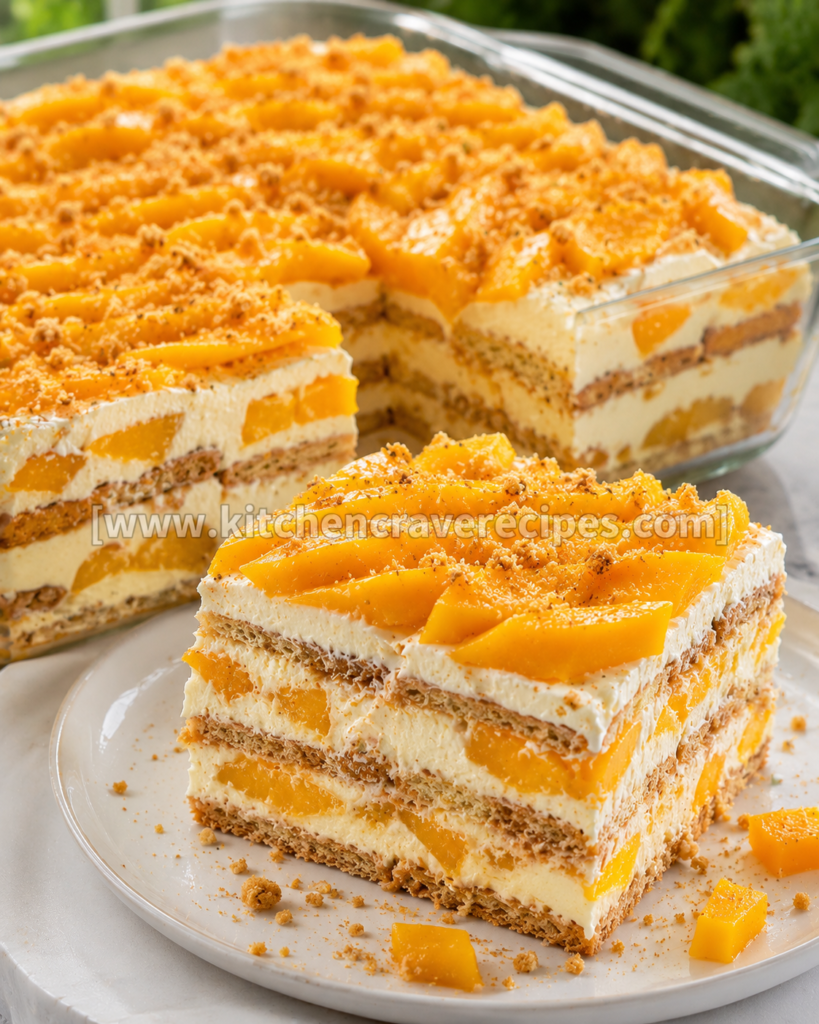
If there is one dessert that manages to look stunning while requiring almost no effort at all, it is a perfectly layered mango creamy biscuit dessert. This icebox-style treat stacks whole graham crackers between waves of lush, vanilla-scented cream filling and slices of golden, ripe mango — then chills in the refrigerator until the crackers soften into tender, cake-like layers that hold their shape when sliced. The top is finished with crushed graham cracker crumbs and a spiral of mango slices arranged in a rose pattern, exactly as shown in the photo.
No oven required for the assembly — but a brief stovetop simmer transforms a handful of mango, sugar, and lime juice into a glossy, vibrant mango sauce that gets drizzled over each layer for an extra layer of tropical flavor. It is the step that takes this dessert from good to genuinely memorable, and it takes under 8 minutes.
Recipe Quick Info
| Detail | Info |
|---|---|
| Prep Time | 20 minutes |
| Cook Time | 8 minutes (mango sauce only) |
| Chill Time | 4 hours minimum (or overnight) |
| Total Time | 4 hours 28 minutes |
| Servings | 9–12 |
| Cuisine | Filipino-Inspired / American |
| Course | Dessert |
| Cooking Method | Simmering (mango sauce) / No-Bake Assembly |
| Calories | ~290 per serving |
| Difficulty | Simple |
Why You’ll Love This Mango Creamy Biscuit Dessert
- No oven needed for the main assembly. The layering process is entirely no-heat — the refrigerator does all the work of setting the cream and softening the crackers.
- The simmered mango sauce is a game-changer. Eight minutes on the stovetop transforms fresh mango into a glossy, concentrated drizzle that elevates every layer from simple to genuinely tropical.
- Stunning presentation, minimal skill required. The spiral mango rose on top looks like something from a professional pastry display and takes about 3 minutes to arrange.
- Fresh mango flavor throughout every bite. Both sliced fresh mango between the layers and the simmered sauce running through the cream ensure you taste the fruit in every single forkful.
- Feeds a crowd from one glass dish. A standard 9×9 dish cuts into 9 generous squares — or 12 smaller portions — making it ideal for potlucks, parties, or family dinners.
- Customize it to your taste. Swap the cream filling for coconut cream, add a layer of toasted coconut, or spike the sauce with a pinch of chili for a grown-up version — the structure holds up under any variation.
Ingredients
For the Mango Cream Filling
- 2 cups heavy whipping cream, cold
- 8 oz cream cheese, softened to room temperature
- ½ cup powdered sugar, sifted
- 1 teaspoon pure vanilla extract
- Pinch of kosher salt
For the Layers
- 14–16 full graham cracker sheets (enough for 3 single layers in a 9×9 dish)
- 3 large ripe mangoes, peeled and sliced thin (about 4 cups total), divided
For the Simmered Mango Sauce
- 1 cup ripe mango, diced (from 1 mango)
- 3 tablespoons granulated sugar
- 2 tablespoons fresh lime juice
- 2 tablespoons water
- Pinch of salt
For the Topping
- ½ cup graham cracker crumbs (from 4–5 cracker sheets, crushed)
- Reserved mango slices, arranged in a spiral rose pattern
Optional Add-Ins
- 1 teaspoon coconut extract (in place of half the vanilla for a tropical twist)
- 1 tablespoon toasted shredded coconut, scattered over the top
- ¼ teaspoon cayenne or chili powder stirred into the mango sauce for a heat contrast
- Zest of 1 lime, folded into the cream filling for brightness
Ingredient Substitutions
| Original Ingredient | Substitution | Notes |
|---|---|---|
| Heavy whipping cream | Full-fat coconut cream (chilled overnight) | Dairy-free; whips to a similar stiff peak with a subtle coconut flavor |
| Cream cheese | Mascarpone cheese | Lighter tang; slightly richer and creamier texture in the filling |
| Graham crackers | Digestive biscuits or Maria cookies | Digestive biscuits are slightly less sweet and soften to the same cake-like texture |
| Fresh mango | Thawed frozen mango slices | Pat dry thoroughly; texture is slightly softer but flavor is comparable |
| Granulated sugar (sauce) | Honey or agave syrup | Adds a floral note; reduce to 2 tablespoons as both are sweeter than sugar |
| Lime juice (sauce) | Lemon juice | Slightly less tropical but works well; same quantity |
Kitchen Tools Needed
- Small saucepan — for simmering the mango sauce over low-to-medium heat; essential for the cooking method component of this recipe
- Silicone spatula or wooden spoon — for stirring the simmering sauce without scorching
- Blender or immersion blender — for pureeing the finished mango sauce to a smooth, pourable consistency
- 9×9 inch glass baking dish — for assembling and chilling the layered dessert
- Stand mixer or hand mixer — for whipping the heavy cream to stiff peaks and beating the cream cheese filling smooth
- Large mixing bowl — for combining the cream cheese and whipped cream into the final filling
- Rubber spatula — for spreading the cream filling evenly between layers without disturbing the crackers
- Sharp knife and cutting board — for slicing the mangoes thin and uniform for layering and the spiral topping
- Fine mesh strainer (optional) — for passing the mango sauce through for an ultra-smooth finish
- Plastic wrap — for covering the assembled dish during chilling
How to Make the Best Mango Creamy Biscuit Dessert Step by Step
Step 1: Simmer the Mango Sauce (8 minutes)
Combine the diced mango, granulated sugar, lime juice, water, and pinch of salt in a small saucepan over medium heat. Stir to dissolve the sugar as the mixture heats — within 2 minutes you’ll see the mango begin to break down at the edges and the liquid around it turn a deep golden-orange. Reduce the heat to medium-low once it reaches a gentle simmer: small, lazy bubbles breaking steadily at the surface, not a rapid rolling boil.
Simmer for 5–6 minutes, stirring occasionally, until the mango is completely soft and the liquid has reduced to a syrupy consistency that coats the back of a spoon. The sauce should smell intensely of tropical fruit — sweet, floral, and slightly tart from the lime. Remove from the heat and allow it to cool for 5 minutes, then blend to a smooth purée using an immersion blender or transfer to a countertop blender. Pass through a fine mesh strainer for an ultra-smooth sauce if desired, then set aside to cool completely.
Embedded Tip: Keep the sauce at a true simmer — small, steady bubbles — not a boil. A rolling boil evaporates the liquid too quickly and can scorch the mango sugars, turning the sauce bitter and dark rather than bright and golden. Low and slow for 5–6 minutes is all it needs.
Step 2: Make the Cream Filling (10 minutes)
Beat the softened cream cheese with an electric mixer on medium speed for 2 minutes until completely smooth and lump-free — it should look like thick, spreadable frosting with no visible chunks. Add the powdered sugar, vanilla extract, and pinch of salt, then beat for another minute until fully combined. The mixture will be dense and slightly stiff at this stage.
In a separate chilled bowl, whip the cold heavy cream on medium-high speed until stiff peaks form — about 3–4 minutes. The cream is ready when it holds a firm peak that stands straight up when the beater is lifted and doesn’t flop over. Fold the whipped cream into the cream cheese mixture in three additions, using a rubber spatula with a gentle under-and-over motion to keep the mixture light and airy.
Embedded Tip: Make sure your heavy cream and bowl are cold before whipping. Room-temperature cream takes significantly longer to reach stiff peaks and can become grainy before it stabilizes. Chill the bowl in the freezer for 10 minutes if your kitchen is warm.
Step 3: Assemble the Layers (10 minutes)
Arrange a single layer of whole graham cracker sheets across the bottom of the 9×9 glass dish — break them as needed to fit the corners and edges so the bottom is completely covered. Spread one-third of the cream filling over the crackers in an even layer using a rubber spatula, going all the way to the edges. Drizzle 2–3 tablespoons of the cooled mango sauce over the cream layer, then arrange a single layer of thin mango slices over the sauce.
Repeat the layering — crackers, cream, mango sauce, mango slices — for a second time, pressing each layer gently but firmly so the stack holds together. Finish with a final layer of graham crackers, then the remaining cream spread smooth and level across the top. This is the surface that will show, so take the extra 30 seconds to get it flat and even.
Step 4: Add the Topping and Chill
Scatter the crushed graham cracker crumbs evenly over the cream surface — they add a sandy, textural contrast to the smooth cream beneath and the soft mango on top. Arrange the reserved mango slices in a spiral rose pattern starting from the outer edge of the dish and working inward, overlapping each slice slightly, exactly as shown in the photo. The finished top should look like a golden flower filling the entire surface of the dish.
Cover the dish tightly with plastic wrap — make sure it touches the surface of the cream to prevent a skin from forming. Refrigerate for a minimum of 4 hours, though overnight chilling produces the best result: the crackers soften fully into a cake-like texture and the cream sets firm enough to slice cleanly. For food-safe chilling practices with dairy-based desserts, refer to FDA guidelines on refrigerating prepared foods.
Step 5: Slice and Serve
Use a sharp knife dipped in warm water and wiped dry between cuts for clean, picture-perfect slices. The layers should be clearly visible from the side — alternating cream, cracker, and mango — with the glossy mango sauce running through each one. Drizzle any remaining mango sauce over individual portions at serving for an extra hit of tropical flavor.
For more tropical no-bake dessert ideas, check out Raspberry Coconut Ice Cream: 5-Ingredient Best & Foolproof Recipe.
Pro Tips for a Perfect Mango Creamy Biscuit Dessert
1. Watch the simmer — never let the sauce boil. The simmering method is all about controlled, gentle heat. The moment the sauce tips into a rolling boil, the mango sugars begin to caramelize and the bright tropical flavor turns darker and more jammy. Stay at medium-low and look for slow, steady bubbles throughout the 5–6 minutes.
2. Chill overnight for the cleanest slices. Four hours is the minimum, but overnight chilling produces a dessert that slices like a cake — clean sides, defined layers, zero sliding. The extra hours allow the crackers to absorb moisture from the cream and soften completely into a tender, cohesive texture.
3. Choose mangoes at peak ripeness. The fruit is the star of this dessert and there is nowhere to hide under-ripe mango. Ripe mangoes give slightly when pressed, smell fragrant at the stem end, and their flesh is deep golden-orange — not pale yellow. If your mangoes aren’t fully ripe, set them on the counter for 1–2 days before using.
4. Spread the cream filling to the very edges of each cracker layer. Cream that doesn’t reach the edges creates dry pockets at the corners of the dish where the crackers don’t soften evenly. Take the extra 20 seconds to push the cream all the way out, and every bite from corner to center will have the same lush, tender texture.
5. Slice mangoes uniformly thin for the spiral topping. The rose pattern on top requires consistent, thin slices — about ⅛ inch thick — that will fan and curve without breaking. A sharp knife and a firm, ripe mango are all you need. Thick, uneven slices won’t lay flat and the spiral won’t hold its shape as it chills.
Common Mistakes to Avoid
1. Letting the mango sauce boil instead of simmer.
A rolling boil evaporates liquid too quickly and scorches the mango sugars, turning the sauce dark and slightly bitter. Reduce heat to medium-low the moment bubbles appear and maintain a gentle, steady simmer throughout. The finished sauce should be bright golden-orange, not dark amber.
2. Using under-ripe mango.
Firm, pale mango has little sweetness and a faintly astringent flavor that becomes even more noticeable against a sweet cream filling. The entire dessert depends on the mango delivering tropical sweetness — use only fragrant, fully ripe fruit. If in doubt, taste a slice before layering.
3. Not softening the cream cheese before beating.
Cold cream cheese will not beat smooth — it clumps and leaves small white lumps in the filling that don’t disappear even with extended mixing. Take it out of the refrigerator 30–45 minutes before you start, or microwave it in 10-second bursts until it yields to a finger poke.
4. Over-whipping the heavy cream.
Heavy cream that is beaten past stiff peaks turns grainy and begins to separate into butter. Stop the mixer the moment the cream holds a firm, straight peak. If it looks curdled or chunky, it has gone too far and the filling will have an unpleasant grainy texture in the finished dessert.
5. Rushing the chill time.
Four hours is the absolute minimum and should be treated as such — not a suggestion. Under-chilled mango creamy biscuit dessert slices into a sliding, messy pile rather than clean, defined layers. If you’re making it for guests, prepare it the night before and let it chill overnight without question.
6. Skipping the plastic wrap contact with the cream surface.
Air contact on the top cream layer during chilling causes a slightly dry, rubbery skin to form — visible and unpleasant in the finished dessert. Press the plastic wrap directly onto the surface of the cream so no air gap exists, and the topping will remain smooth and fresh through the full chill period.
7. Cutting slices with a dry knife.
The cream filling sticks to a dry blade and drags through the layers rather than cutting cleanly. Dip the knife in warm water and wipe it dry between every cut — even for just 9 slices. This single habit makes the difference between a dessert that photographs beautifully and one that looks pulled apart.
Variations
Lighter Version: Greek Yogurt Cream Filling
Replace the cream cheese with 8 oz of full-fat plain Greek yogurt, drained through a cheesecloth for 30 minutes to remove excess liquid. The filling will be slightly less rich but still thick, tangy, and delicious. Reduce the powdered sugar to ⅓ cup since Greek yogurt’s natural tartness means less sweetness is needed. The assembly and chilling method stay exactly the same.
Dairy-Free Version
Use full-fat coconut cream (chilled overnight so the solid cream separates from the liquid) in place of both the heavy whipping cream and the cream cheese. Scoop the solid portion and beat it until fluffy — it reaches stiff peaks in about 3 minutes and has a natural coconut flavor that complements mango beautifully. Use dairy-free graham crackers or digestive biscuits to keep the entire dessert free of dairy.
Tropical Layered Version
Add a thin layer of toasted shredded coconut between the cream and mango slices on each layer. Stir 1 teaspoon of coconut extract into the cream filling alongside the vanilla. A pinch of lime zest in the cream adds a bright citrus note that brings all the tropical flavors together. The assembly, structure, and chill time remain identical to the original.
Spicy Mango Version (Adults)
Stir ¼ teaspoon of cayenne pepper and ½ teaspoon of Tajín seasoning directly into the simmered mango sauce before pureeing. The heat blooms beautifully in the warm sauce and mellows during chilling, leaving a lingering warmth against the sweet cream and fruit that reads as sophisticated rather than aggressive. Keep the cream filling as-is — the contrast between cool, plain cream and spiced sauce is what makes this version work.
Gluten-Free Version
Swap the standard graham crackers for certified gluten-free graham crackers (several brands are widely available in US grocery stores) or gluten-free digestive biscuits. Every other ingredient in this recipe — cream, cream cheese, mango, sugar, lime juice — is naturally gluten-free. The texture and chill time are identical to the original.
What to Serve With This Mango Creamy Biscuit Dessert
This dessert is rich and satisfying on its own, but these accompaniments make it a full spread:
- A drizzle of extra simmered mango sauce — serve the remaining sauce in a small pitcher at the table for guests to add to their own slices.
- Fresh mint leaves — a single sprig on each plate adds a clean, herbal contrast to the sweetness.
- Chilled sparkling water with lime — the carbonation and acidity cut through the cream filling and refresh the palate between bites.
- A scoop of vanilla bean or coconut ice cream — cold, creamy, and a natural bridge between the cream filling and the fresh fruit.
- Lightly sweetened cold brew coffee — the slight bitterness of cold brew balances the tropical sweetness of the mango beautifully.
- Toasted coconut flakes in a small bowl — let guests sprinkle them over their portions for added crunch and flavor.
- A fresh fruit platter — sliced papaya, pineapple, and kiwi alongside the dessert makes a tropical spread perfect for summer entertaining. Pair with Best Chicken Broccoli Pasta Bake (35-Min Ultimate Dinner) for a complete tropical dessert table.
Storage Instructions
Refrigerator
Store the assembled mango creamy biscuit dessert covered tightly with plastic wrap (pressed directly onto the cream surface) in the refrigerator for up to 3 days. The crackers continue to soften slightly each day, which most people find makes the texture even better on day two. After day three, the cream can begin to weep slightly at the edges. Store any extra mango sauce in a small jar separately for up to 5 days.
Freezer
This dessert can be frozen for up to 1 month if wrapped very tightly in two layers of plastic wrap followed by foil. The fresh mango slices will soften considerably upon thawing and won’t hold their spiral arrangement, so the frozen version is better suited to serving as a more casual, scooped dessert. Thaw overnight in the refrigerator — do not thaw at room temperature, as the cream filling may separate.
Shelf Life Summary
| Component | Refrigerator | Freezer |
|---|---|---|
| Fully assembled dessert | Up to 3 days | Up to 1 month |
| Mango sauce (separate jar) | Up to 5 days | Up to 2 months |
| Whipped cream filling (alone) | Up to 2 days | Not recommended |
| Sliced fresh mango (separate) | Up to 2 days | Up to 3 months |
Serving and “Reheating” Notes
This is a chilled dessert — it is not reheated. However, these serving temperature notes ensure the best experience:
Serving Directly from the Refrigerator: The texture is firmest and slices most cleanly straight from the refrigerator. This is the ideal serving condition. Use a knife dipped in warm water and wiped dry between cuts.
Bringing to Room Temperature: If you prefer a softer, more mousse-like texture, remove the dish from the refrigerator 10–15 minutes before serving. The cream softens slightly and the mango releases more aroma at a slightly warmer temperature. Do not leave it out for more than 20 minutes, as per FDA guidance on safe dairy food handling, cream-based desserts should not sit at room temperature for extended periods.
Mango Sauce: If the reserved mango sauce has been refrigerated, warm it briefly in a small saucepan over low heat for 2 minutes until pourable, or microwave for 20–30 seconds. Stir before drizzling.
Nutrition Facts (Per Serving, based on 12 servings)
| Nutrient | Amount |
|---|---|
| Calories | ~290 |
| Total Fat | 18g |
| Saturated Fat | 10g |
| Cholesterol | 55mg |
| Sodium | 140mg |
| Total Carbohydrates | 30g |
| Dietary Fiber | 1g |
| Sugars | 18g |
| Protein | 3g |
Nutrition Disclaimer: All nutritional values are estimates calculated using standard ingredient databases and will vary depending on the specific brands used, mango size and ripeness, portion sizes, and any substitutions. These figures are provided as general guidance only and do not constitute medical or dietary advice. For precise tracking, use a verified nutrition calculator with your exact measured ingredients.
Frequently Asked Questions
1. Does the mango sauce actually need to be simmered, or can I skip it?
You can skip the simmered sauce and drizzle with store-bought mango nectar or mango jam thinned with lime juice instead. However, the simmered version concentrates the mango flavor significantly and adds a glossy, professional finish to each layer that packaged products don’t replicate. Eight minutes is genuinely worth it for the flavor payoff.
2. How do I get the spiral mango rose on top to hold its shape?
Slice the mango very thin — about ⅛ inch — using a sharp knife. Start at the outer edge of the dish and slightly overlap each slice as you work inward in a spiral. Press each slice gently into the cream surface so it adheres slightly rather than sitting loose on top. Once the dish is covered in plastic wrap and refrigerated, the pattern sets into place.
3. Can I use canned mango instead of fresh?
Canned mango in syrup works, but drain and rinse it thoroughly — canned mango is significantly sweeter and moister than fresh, and the extra syrup will make the cream layers wet and the crackers soggy faster. Pat the slices completely dry before layering. Reduce the sugar in the mango sauce to 1 tablespoon if using canned mango.
4. Why do the graham crackers need to soften — can I keep them crispy?
The softening of the crackers during chilling is intentional and is what transforms this from a cracker-and-cream snack into a proper sliceable dessert. The moisture from the cream filling is absorbed by the crackers over 4+ hours, turning them into a tender, cake-like layer. If you prefer crunch, serve the dessert immediately after assembly — but it won’t slice cleanly and the crackers will shatter.
5. My cream filling is too runny — what went wrong?
The most common cause is cream cheese that wasn’t fully softened before beating (creating a lumpy, uneven filling that appears thin) or heavy cream that was whipped at room temperature rather than cold. Both issues prevent the filling from reaching a stable, thick consistency. Make sure both the cream cheese is room-temperature soft and the heavy cream is fridge-cold before starting.
6. Can I make individual portions instead of one large dish?
Absolutely — use individual serving glasses, ramekins, or small mason jars. Break the graham crackers to fit the diameter of each vessel and layer as directed. Individual portions set slightly faster (about 3 hours) since the layers are thinner, and they’re elegant for serving at a dinner party without slicing. They also store more neatly in the refrigerator.
7. How far in advance can I make this dessert?
The mango creamy biscuit dessert is at its best when made 12–24 hours ahead. The crackers have fully softened, the cream has set firmly, and the mango sauce has integrated into each layer. Beyond 48 hours, the mango begins to release juice and the cream layers can become slightly wet at the edges — still delicious, but less structurally perfect.
8. Is there a way to make this dessert lower in sugar?
Reduce the powdered sugar in the cream filling to ¼ cup — the cream cheese and vanilla still provide plenty of flavor and sweetness. In the mango sauce, reduce the sugar to 1½ tablespoons and let the ripe mango carry the sweetness naturally. Using very ripe mango throughout is the most effective way to reduce added sugar without losing the dessert’s sweetness.
9. What if I can’t find ripe mangoes?
Thawed frozen mango slices are the best substitute — they are typically frozen at peak ripeness and deliver consistent flavor. Pat them completely dry before using, as excess moisture will make the cream layers wet. For the simmered sauce, frozen mango works beautifully since it breaks down quickly in the pan.
10. Can I add a layer of gelatin to stabilize the cream for longer storage?
Yes — dissolve 1 teaspoon of unflavored gelatin in 2 tablespoons of warm water and fold it into the cream cheese mixture before adding the whipped cream. This stabilizes the filling so it holds its shape for up to 5 days in the refrigerator without weeping. It does slightly firm the texture of the filling, making it closer to a set mousse than a fresh whipped cream.
Expert Chef Tips
1. Taste your mango before committing to the recipe. Mango sweetness varies enormously depending on variety and ripeness. A very sweet mango may need the sauce sugar reduced to 2 tablespoons; an under-ripe mango may need an extra tablespoon of sugar and another squeeze of lime. Adjusting at the sauce stage is your best and only opportunity to calibrate the flavor of the whole dessert before assembly.
2. Use a bench scraper or offset spatula for level cream layers. A rubber spatula gets the cream close to even, but an offset spatula or bench scraper pulled across the surface in one smooth motion gives you the perfectly flat, level cream layer that makes the spiral mango topping look professional rather than lumpy. It takes 5 extra seconds and is entirely worth it.
3. Line the dish with plastic wrap for easier serving. Press plastic wrap across the bottom and up the sides of the 9×9 dish before assembling, leaving an overhang on all four sides. After chilling, lift the entire dessert out of the dish using the overhang, set it on a cutting board, and slice it there for cleaner cuts and easier portioning — especially for the first piece, which is always the hardest to extract from a glass dish.
4. Add the mango sauce while it is still slightly warm, not hot. The sauce drizzled between the cream layers should be warm enough to flow easily and spread itself evenly, but not so hot that it begins to melt the cream filling beneath it. Let the simmered sauce cool for 8–10 minutes off the heat before drizzling — warm is the goal, not steaming.
5. Crush the graham cracker topping just before assembly, not ahead of time. Crumbs that sit exposed to air begin to absorb ambient humidity and lose their sandy, light texture. Crush them in a zip-top bag with a rolling pin just before scattering them over the finished cream layer — fresh crumbs have a noticeably better texture and a crisper contrast against the soft cream surface.
Recipe Summary
This mango creamy biscuit dessert is a layered, no-bake icebox-style treat built from whole graham crackers, a whipped cream cheese filling, fresh mango slices, and a quick simmered mango-lime sauce that runs through every layer with concentrated tropical flavor. The entire dessert chills in a 9×9 glass dish for a minimum of 4 hours — overnight for best results — until the crackers soften to a tender, cake-like texture and the cream sets firm enough to slice cleanly. Topped with crushed cracker crumbs and a spiral of mango slices, it is one of those rare desserts that looks like it took hours and actually took under 30 minutes of active effort.
Make It Once and It Will Become Your Go-To Summer Dessert
There is something genuinely satisfying about pulling a dessert out of the refrigerator that looks this good and knowing it took less than 30 minutes of actual work. This mango creamy biscuit dessert rewards patience — the longer it chills, the better it gets — and it rewards ripe, good fruit with a flavor that needs no enhancement beyond what the recipe already provides. Make it for a party, bring it to a potluck, or simply make it on a Sunday night and enjoy slices through the week. Either way, it never lasts as long as you expect. Looking for more easy no-bake desserts built around fresh fruit?
Mango Creamy Biscuit Dessert: 5-Layer Ultimate
Description
If there is one dessert that manages to look stunning while requiring almost no effort at all, it is a perfectly layered mango creamy biscuit dessert. This icebox-style treat stacks whole graham crackers between waves of lush, vanilla-scented cream filling and slices of golden, ripe mango — then chills in the refrigerator until the crackers soften into tender, cake-like layers that hold their shape when sliced. The top is finished with crushed graham cracker crumbs and a spiral of mango slices arranged in a rose pattern, exactly as shown in the photo.
Ingredients
Instructions
-
How to Make the Best Mango Creamy Biscuit Dessert Step by Step
-
Step 1: Simmer the Mango Sauce (8 minutes)
-
Combine the diced mango, granulated sugar, lime juice, water, and pinch of salt in a small saucepan over medium heat. Stir to dissolve the sugar as the mixture heats — within 2 minutes you'll see the mango begin to break down at the edges and the liquid around it turn a deep golden-orange. Reduce the heat to medium-low once it reaches a gentle simmer: small, lazy bubbles breaking steadily at the surface, not a rapid rolling boil.
-
Simmer for 5–6 minutes, stirring occasionally, until the mango is completely soft and the liquid has reduced to a syrupy consistency that coats the back of a spoon. The sauce should smell intensely of tropical fruit — sweet, floral, and slightly tart from the lime. Remove from the heat and allow it to cool for 5 minutes, then blend to a smooth purée using an immersion blender or transfer to a countertop blender. Pass through a fine mesh strainer for an ultra-smooth sauce if desired, then set aside to cool completely.
-
Embedded Tip: Keep the sauce at a true simmer — small, steady bubbles — not a boil. A rolling boil evaporates the liquid too quickly and can scorch the mango sugars, turning the sauce bitter and dark rather than bright and golden. Low and slow for 5–6 minutes is all it needs.
-
Step 2: Make the Cream Filling (10 minutes)
-
Beat the softened cream cheese with an electric mixer on medium speed for 2 minutes until completely smooth and lump-free — it should look like thick, spreadable frosting with no visible chunks. Add the powdered sugar, vanilla extract, and pinch of salt, then beat for another minute until fully combined. The mixture will be dense and slightly stiff at this stage.
-
In a separate chilled bowl, whip the cold heavy cream on medium-high speed until stiff peaks form — about 3–4 minutes. The cream is ready when it holds a firm peak that stands straight up when the beater is lifted and doesn't flop over. Fold the whipped cream into the cream cheese mixture in three additions, using a rubber spatula with a gentle under-and-over motion to keep the mixture light and airy.
-
Embedded Tip: Make sure your heavy cream and bowl are cold before whipping. Room-temperature cream takes significantly longer to reach stiff peaks and can become grainy before it stabilizes. Chill the bowl in the freezer for 10 minutes if your kitchen is warm.
-
Step 3: Assemble the Layers (10 minutes)
-
Arrange a single layer of whole graham cracker sheets across the bottom of the 9×9 glass dish — break them as needed to fit the corners and edges so the bottom is completely covered. Spread one-third of the cream filling over the crackers in an even layer using a rubber spatula, going all the way to the edges. Drizzle 2–3 tablespoons of the cooled mango sauce over the cream layer, then arrange a single layer of thin mango slices over the sauce.
-
Repeat the layering — crackers, cream, mango sauce, mango slices — for a second time, pressing each layer gently but firmly so the stack holds together. Finish with a final layer of graham crackers, then the remaining cream spread smooth and level across the top. This is the surface that will show, so take the extra 30 seconds to get it flat and even.
-
Step 4: Add the Topping and Chill
-
Scatter the crushed graham cracker crumbs evenly over the cream surface — they add a sandy, textural contrast to the smooth cream beneath and the soft mango on top. Arrange the reserved mango slices in a spiral rose pattern starting from the outer edge of the dish and working inward, overlapping each slice slightly, exactly as shown in the photo. The finished top should look like a golden flower filling the entire surface of the dish.
-
Cover the dish tightly with plastic wrap — make sure it touches the surface of the cream to prevent a skin from forming. Refrigerate for a minimum of 4 hours, though overnight chilling produces the best result: the crackers soften fully into a cake-like texture and the cream sets firm enough to slice cleanly. For food-safe chilling practices with dairy-based desserts, refer to FDA guidelines on refrigerating prepared foods.
-
Step 5: Slice and Serve
-
Use a sharp knife dipped in warm water and wiped dry between cuts for clean, picture-perfect slices. The layers should be clearly visible from the side — alternating cream, cracker, and mango — with the glossy mango sauce running through each one. Drizzle any remaining mango sauce over individual portions at serving for an extra hit of tropical flavor.
Nutrition Facts
Servings 9
- Amount Per Serving
- Calories 290kcal
- % Daily Value *
- Total Fat 18g28%
- Saturated Fat 10g50%
- Protein 3g6%
* Percent Daily Values are based on a 2,000 calorie diet. Your daily value may be higher or lower depending on your calorie needs.